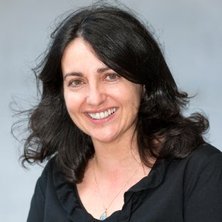
My research is in the area of Economics of Banking, with a particular interest for modelling of competition and contract design in asymmetric information environments. Since 2012 my interests have increasingly moved towards Scholarship of Teaching and Learning.
Qualifications
PhD (Facultés Universitaires Notre-Dame de la Paix, Namur, Belgium)
MSC (Université Catholique de Louvain, Louvain-la-Neuve, Belgium) ;
Profile Employment record
Since October 2006
Lecturer at the School of Economics, University of Queensland, Australia.
September, 2000 - August, 2006
Lecturer at the Department of Economics, Keele University, UK.
September, 1998 - August, 2000
Lecturer at the Department of Economics and Accounting, University of Liverpool, UK.
October, 1989 - December, 1997
Teaching and Research Assistant at Facultés Universitaires Notre-Dame de la Paix, Namur, Belgium.
Research Interests
My research in Banking theory revolves around five main areas:
Money supply endogeneity
Bank deposit optimal contracts
Auctions applied to central banking
Modelling of banking competition
Asymmetric information and credit rationing by banks
My interests in Scholarship of Teaching are:
Financial literacy of university students
Incentive mechanisms in students` commitment to learning
Publications
Bracoud, F. (2007) “Double Bertrand Competition among Intermediaries when Consumers can Default”, The Economics Bulletin, Vol. 4.
Bracoud, F. and Hillier, B. (2000) “Equity or Debt? Contracts in Markets with Asymmetric Information”, the Manchester School, Vol. 68, No. 1, pp 1-22.
Working Papers
Bracoud, F. (2002) “Sequential Models of Bertrand Competition for Deposits and Loans under Asymmetric Information”, Keele Economic Research Paper, KERP 2002/15
Bracoud, F. (2000) “On Monetary Implications of Credit Rationing under Asymmetric Information”, Keele Economic Research Paper, KERP 2000/10
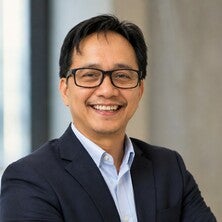
Dr Anthony Halog: Expert in Circular Economy, Life Cycle Thinking, and Sustainable Systems
Dr. Anthony B. Halog is a professor at the University of Queensland specialising in circular economy, sustainability engineering, industrial ecology, and life cycle assessment (LCA/LCSA). His current work focuses on designing low-carbon, net-zero, and resource-efficient systems to address climate change, waste reduction, and sustainable development.
Dr. Halog works across energy, materials, food, waste, and policy systems, applying systems thinking, life cycle sustainability assessment, digital twins, and artificial intelligence for sustainability. His research helps governments, industries, and communities make evidence-based decisions that reduce emissions, improve resource efficiency, and avoid unintended environmental impacts.
A core focus of his work is transforming linear value chains into circular value chains, supporting green hydrogen, bioenergy, circular bioeconomy, agricultural waste valorisation, waste-to-energy, and sustainable materials. These solutions contribute to decarbonisation, climate resilience, sustainable supply chains, and the green economy.
Key areas of expertise
Circular economy and industrial ecology
Life cycle assessment and sustainability metrics
Green hydrogen, bioenergy, and clean energy transitions
Sustainable waste management and circular bioeconomy
Systems modelling, AI-enabled tools, and sustainability policy
Dr. Halog collaborates with policymakers, industry partners, SMEs, and Indigenous communities in Australia and internationally to deliver practical climate solutions and support the transition to decarbonised circular economies.