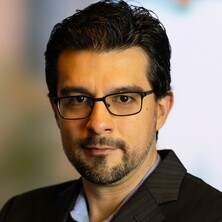
Dr Jorge Campos-González-Angulo develops theoretical and computational models for quantum molecular systems, working at the interface of quantum chemistry, molecular photonics, and quantum computing. His research is part of the quantum decarbonisation mission of the Queensland Quantum Decarbonisation Alliance, providing the physical models needed to simulate and engineer molecular systems for clean energy and quantum technology applications.
His work on light–matter interaction spans from single molecules to collective quantum optical regimes, with applications in the design of organic light-emitting materials for sustainable electronics. A parallel line of research develops reduced models for spin-vibronic systems at molecule–electrode interfaces, with relevance to quantum sensing and electrochemical energy conversion. He also builds physically motivated molecular models that serve as rigorous benchmarks for fault-tolerant quantum computers, connecting advances in quantum hardware directly to chemical problems of practical importance.
Jorge completed his PhD in Chemistry at the University of California San Diego, where he worked with Prof. Joel Yuen-Zhou on foundational problems in vibropolaritonic chemistry. He then joined the Matter Lab of Prof. Alán Aspuru-Guzik at the University of Toronto as a Postdoctoral Fellow, where he was also an affiliate of the Vector Institute for Artificial Intelligence. He joined the University of Queensland in 2026 as a Lecturer jointly appointed in the Schools of Mathematics & Physics and Chemistry & Molecular Biosciences, and is a Chief Investigator at the ARC Centre of Excellence in Quantum Biotechnology (QUBIC).
Affiliate of ARC COE for Engineered Quantum Systems (EQUS)
ARC COE for Engineered Quantum Systems
Faculty of Science
Associate Professor
School of Mathematics and Physics
Faculty of Science
Availability:
Available for supervision
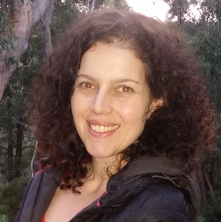
Jacinda Ginges is a theoretical physicist in the School of Mathematics and Physics at UQ. Her research is directed towards atomic tests of fundamental physics, involving development and application of high-precision many-body methods for heavy atoms. Her areas of expertise include high-precision studies of fundamental symmetries violations (parity, time) and probes of nuclear structure. Atomic parity violation studies provide some of the tightest constraints on possible new physics beyond the standard model of particle physics, complementing searches for new physics at the LHC and dark matter searches. Studies of parity- and time-reversal-violating atomic electric dipole moments tightly constrain possible new sources of CP-violation appearing in theories beyond the standard model.
Positions:
2024- Associate Professor, The University of Queensland, Australia
2018- Senior Lecturer, The University of Queensland, Australia
2018-2022 ARC Future Fellow, The University of Queensland, Australia
2017 Research Fellow, ARC Centre of Excellence for Engineered Quantum Systems, The University of Sydney, Australia
2014-2016 Senior Research Associate, UNSW Sydney, Australia
2004-2008 ARC Australian Postdoctoral Fellow and Lecturer, UNSW Sydney, Australia
2004 Avadh Bhatia Postdoctoral Fellowship for Women, University of Alberta, Canada
Australian Institute for Bioengineering and Nanotechnology
Availability:
Available for supervision
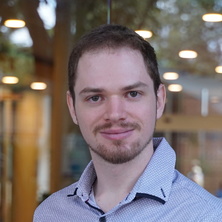
Dr Stephen Sanderson is an expert in nonequilibrium molecular dynamics simulation, with a particular interest in fundamental theory and method development. His current research focuses on developing new methods based in response theory for efficient calculation of nonequilibrium steady state properties, with applications in fluid dynamics, energy materials, heat flow, and quantum systems, among others. Previously, Stephen worked as a Postdoctoral Research Fellow in the group of Prof. Debra Bernhardt, where his focus was on nonequilibrium thermodynamics and statistical mechanics theory, and improving capacity for molecular dynamics simulation of fluids. He holds undergraduate degrees in electrical engineering and physics and a PhD in physics from James Cook University, during which he developed and applied kinetic Monte-Carlo simulations of charge and exciton dynamics coupled with atomistic molecular dynamics deposition simulations to establish a better understanding of structure-property relationships in organic semiconductors, particularly organic light-emitting diodes.
Centre Director of ARC COE for Engineered Quantum Systems (EQUS)
ARC COE for Engineered Quantum Systems
Faculty of Science
ARC Australian Laureate Fellow
School of Mathematics and Physics
Faculty of Science
Availability:
Available for supervision
Media expert
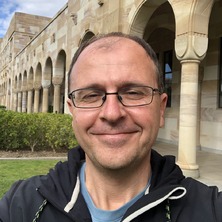
Professor White leads the Quantum Technology Laboratory at UQ, which he established in 1999, and is an Australian Research Council Laureate Fellow. He is internationally recognised for research in quantum science and technology, and is interested in all aspects of quantum weirdness. He is a Fellow of the Australian Academy of Science, the American Physical Society, and Optica. Andrew’s research spans: quantum foundations; production, manipulation and exploitation of quantum states of light, both in conventional optics and nanophotonics; and utilising quantum technology, be it in quantum computation, quantum communication, quantum sensing, or neuromorphic computing. Details can be found at the Quantum Laboratory website.
Professor White has worked with twenty-two postdoctoral researchers since 2001, five of whom received ARC Discovery Early Career Researchers Awards whilst working in his lab, six receiving Marie Skłodowska-Curie Fellowships subsequently and one a Erwin Schrödinger Fellowship. He has supervised more than 40 postgraduate students, who have received an array of awards including a Rhodes Scholarship, three Springer PhD thesis prizes, Australian representative at the Lindau Nobel Meeting, the only-ever runner for the Australian Institute of Physics Bragg Medal, and UQ Medals and Valedictorian, to name but a few.
Bio: Andrew was raised in a Queensland dairy town, before heading south to the big smoke of Brisbane to study chemistry, maths, physics and, during the World Expo, the effects of alcohol on uni students from around the world. Deciding he wanted to know what the cold felt like, he first moved to Canberra, then Germany—completing his PhD in quantum physics—before moving on to Los Alamos National Labs in New Mexico where he quickly discovered that there is more than enough snow to hide a cactus, but not nearly enough to prevent amusing your friends when you sit down. Over the years he has conducted research on various topics including shrimp eyes, nuclear physics, optical vortices, and quantum computers. He likes quantum weirdness for its own sake, but his current research aims to explore and exploit the full range of quantum behaviours—notably entanglement—with an eye to engineering new technologies and scientific applications. He is currently Director of the Centre of Engineered Quantum Systems, an Australia-wide, 14-year long, research effort by more than 250 scientists to build quantum machines that harness the quantum world for practical applications.