Affiliate of Centre for Environmental Responsibility in Mining
Centre for Environmental Responsibility in Mining
Faculty of Engineering, Architecture and Information Technology
Affiliate of Centre for Geoanalytical Mass Spectrometry
Centre for Geoanalytical Mass Spectrometry
Faculty of Science
Professorial Research Fellow
Sustainable Minerals Institute
Faculty of Engineering, Architecture and Information Technology
Availability:
Available for supervision
Media expert
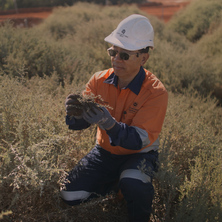
Professor Longbin Huang is a Full Professor and leader of an interdisciplinary research group in Ecological Engineering in Mining. His research focuses on mine waste rehabilitation, ecological engineering, and geomicrobial soil formation, integrating ecological, microbiological, and environmental processes to address sustainability challenges in the mining sector, with influence spanning industry, academia, and policy. Professor Huang leads cutting-edge research in: Geo-microbial ecology, Mineral bioweathering, Microbially and rhizosphere driven soil formation from Tailings Minerals.
Professor Huang's work has advanced nature-based solutions for transforming mine tailings, waste rock, and bauxite residues into sustainable ecosystems. Supported by approximately AUD $23 million in competitive and industry-funded research over the past 15 years, his team has developed and demonstrated innovative rehabilitation technologies with field-scale applications. These include a pioneering technology for the treatment and dealkalization of bauxite residues, which has been commercialized through the University of Queensland startup Bioculum Pty Ltd, and novel approaches for preventing acid mine drainage generation in mine waste materials.
Professor Huang has published over 190 scholarly outputs, including journal articles, conference papers, patents, and book chapters. His research has attracted broad international recognition and has contributed significantly to the advancement of mine waste management, ecological restoration, and sustainable mining practices worldwide.
He is highly experienced in industry-partnered research and translation of knowledge into field-based technologies for tackling large environmental challenges in the mining industry, for example, technologies for tackling global tailings problem. Since 2010, he has led many large and industry-partnered research projects attracting about $23M funding. The research aims to deliver transformative knowledge and practices (i.e., technologies/methdologies) in the rehabilitation of mine wastes (e.g., tailings, mineral residues, spoils, waste rocks) and mined landscapes for non-polluting and ecologically and financially sustainable outcomes. Prof Huang has successfully demonstrated innovative methodology and technology to achieve nature-based outcomes in treating and rehabilitating tailings and waste rocks. Prof Huang’s research program was featured in Rio Tinto’s media releases as one of the four most successful global R&D partnerships in 2024. Prof Huang led the development of the first field-feasible technology to treat and dealkalize alkaline bauxite residues for sustainable rehabilitation. His industry-partnered research was recognised in 2019 UQ’s Partners in Research Excellence Award (Resilient Environments) (Rio Tinto and QAL). Prof Huang is also developing new knowledge and technologies for achieving non-polluting and ecologically sustainable rehabilitation of, for example, coal mine spoils and tailings, Fe-ore tailings, bauxite tailings (from mining bauxite), and Cu/Pb-Zn tailings.
Membership of Board, Committee and Society
Professional associations and societies
2010 – Present Australian Soil Science Society.
2023 – Present AuSIMM
2015 – 2025 Present American Society of Mining and Reclamation (ASMR)
Editorial boards/services
2025 - present: Member of Editorial Board, Energy & Environment Nexus
Faculty of Engineering, Architecture and Information Technology
Affiliate Research Fellow of School of the Environment
School of the Environment
Faculty of Science
Affiliate of UQ Centre for Natural Gas
UQ Gas & Energy Transition Research Centre
Faculty of Engineering, Architecture and Information Technology
Availability:
Available for supervision
Media expert
Julie’s research is mainly focussed on gas-water-rock core reactivity at reservoir conditions using experimental, field, and geochemical modelling techniques. Recent projects have been in the application of carbon dioxide geological storage in which CO2 is captured and stored in formations generally contained by low permeability cap-rock. The safe containment of the injected CO2 and the potential changes to rock porosity, permeability, and water quality should be determined. Recent and current projects with a focus on a demonstration site in the Surat Basin (Precipice Sandstone) include the impacts of impurity or acid gases present in industrial CO2 streams (collaboration with D. Kirste, SFU), inducing carbonate precipitation (in collaboration with S. Golding), and understanding dissolved metal sources and fate. Julie has also worked closely with the CO2CRC, CTSCo, Glencore, SEAL, the NSW government, CI-NSW, and ANLEC R&D, and provided expert opinion to the Queensland Government, and input to Environmental Impacts Assessments.
Julie is currently working with landholders, the QLD regional government, RDMW, councils and industry to understand the sources of methane in aquifers of the Great Artesian Basin, especailly those overlying coal seam gas reservoirs (CSG) (with Arrow Energy, SANTOS, APLNG, H. Hoffman, K, Baublys).
Other projects include gas-water-rock or acid-rock reactivity that modify nano-porosity and gas flow in gas or oil bearing shales.
Julie Pearce graduated with an MCHEM (Hons) degree in Chemistry from the University of York, UK. She then moved to the University of Bristol to complete a Ph.D. in 2007 focusing on laser spectroscopic studies to understand the detailed reaction dynamics of atmospheric processes. From 2007 – 2009 she accepted a Japan Society for the Promotion of Science Postdoctoral Fellowship, hosted at Nagoya University, Japan. There she measured delta 13C and delta 18O isotopic signatures of CO2 simultaneously in real time in the atmosphere using a laser spectroscopic technique to understand anthropogenic and biogenic sources of CO2. After taking a career break to travel in 15 countries in Asia, she moved to Brisbane in 2010 where she is enjoying the surrounding natural beauty of Queensland.
Affiliate of Queensland Alliance for Environmental Health Science
Queensland Alliance for Environmental Health Sciences
Faculty of Health, Medicine and Behavioural Sciences
Affiliate of Minderoo Centre for Plastics and Human Health
Minderoo Centre for Plastics and Human Health
Faculty of Health, Medicine and Behavioural Sciences
Senior Research Fellow
School of Pharmacy and Pharmaceutical Sciences
Faculty of Health, Medicine and Behavioural Sciences
Availability:
Available for supervision
Media expert
Cassandra is a Senior Research Fellow at the Queensland Alliance for Environmental Health Sciences (QAEHS), joining the group in 2019. She is the microplastics project lead in the Minderoo Centre-Plastics and Human Health, investigating human exposure to microplastics and developing new methods for detecting micro and nanoplastics in human matrices. Her other research interests include the impact of tyre road wear particles and their chemical additives on the environment and developing novel biomonitoring methods for assessing human exposure to chemicals of concern.