
Overview
Background
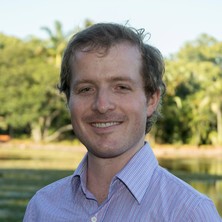
Dr. Matthew Holden is an applied mathematician using modelling to improve environmental outcomes. Mathematical tools unify his research across several diverse topics in biodiversity conservation, theoretical ecology, fisheries, and other branches of natural resource management. He is especially interested in how we improve the well-being of human populations at least cost to biodiversity.
Dr. Holden currently serves as the President of the Resource Modeling Association, an international society of economists, mathematicians, and envrionmental scientists unified via their passion for modelling and other quantitative methods to solve the world's hardest natural resource management problems. He also is the Deputy Director of Research for the Centre for Biodiversity and Conservation Science (CBCS), and is also affiliated with the Centre for Marine Science (CMS).
Dr. Holden was awarded his Ph.D. in Applied Mathematics at Cornell University, where he used dynamical systems, optimal control, and statistical theory to recommend policies to improve the management of invasive species, agricultural pests, and fisheries. He received his bachelor’s degree from the University of California, Davis, where he won the University Medal, working on the effect of habitat fragmentation on the persistence of endangered species.
Availability
- Dr Matthew Holden is:
- Available for supervision
- Media expert
Fields of research
Qualifications
- Doctoral Diploma, Cornell University
Works
Search Professor Matthew Holden’s works on UQ eSpace
2023
Journal Article
Navigating sustainability trade-offs in global beef production
Castonguay, Adam C., Polasky, Stephen, H. Holden, Matthew, Herrero, Mario, Mason-D’Croz, Daniel, Godde, Cecile, Chang, Jinfeng, Gerber, James, Witt, G. Bradd, Game, Edward T., A. Bryan, Brett, Wintle, Brendan, Lee, Katie, Bal, Payal and McDonald-Madden, Eve (2023). Navigating sustainability trade-offs in global beef production. Nature Sustainability, 6 (3), 284-294. doi: 10.1038/s41893-022-01017-0
2022
Journal Article
Modeling total predation to avoid perverse outcomes from cat control in a data‐poor island ecosystem
Plein, Michaela, O'Brien, Katherine R., Holden, Matthew H., Adams, Matthew P., Baker, Christopher M., Bean, Nigel G., Sisson, Scott A., Bode, Michael, Mengersen, Kerrie L. and McDonald‐Madden, Eve (2022). Modeling total predation to avoid perverse outcomes from cat control in a data‐poor island ecosystem. Conservation Biology, 36 (5) e13916. doi: 10.1111/cobi.13916
2022
Journal Article
From climate change to pandemics: decision science can help scientists have impact
Baker, Christopher M., Campbell, Patricia T., Chades, Iadine, Dean, Angela J., Hester, Susan M., Holden, Matthew H., McCaw, James M., McVernon, Jodie, Moss, Robert, Shearer, Freya M. and Possingham, Hugh P. (2022). From climate change to pandemics: decision science can help scientists have impact. Frontiers in Ecology and Evolution, 10 792749. doi: 10.3389/fevo.2022.792749
2021
Journal Article
Invasive wild pigs (Sus scrofa) as a human‐mediated source of soil carbon emissions: Uncertainties and future directions
O’Bryan, Christopher J., Patton, Nicholas R., Hone, Jim, Lewis, Jesse S., Berdejo‐Espinola, Violeta, Risch, Derek R., Holden, Matthew H. and McDonald‐Madden, Eve (2021). Invasive wild pigs (Sus scrofa) as a human‐mediated source of soil carbon emissions: Uncertainties and future directions. Global Change Biology, 28 (3), e1-e3. doi: 10.1111/gcb.15992
2021
Newspaper Article
Los jabalíes, una de las especies invasoras más dañinas, liberan cada año las mismas emisiones que un millón de automoviles
O'Bryan, Christopher J., McDonald-Madden, Eve, Hone, Jim, Holden, Matthew H. and Patton, Nicholas R. (2021, 07 23). Los jabalíes, una de las especies invasoras más dañinas, liberan cada año las mismas emisiones que un millón de automoviles The Conversation
2021
Newspaper Article
‘One of the most damaging invasive species on Earth’: wild pigs release the same emissions as 1 million cars each year
O'Bryan, Christopher J., McDonald-Madden, Eve, Hone, Jim , Holden, Matthew H. and Nicholas R. Patton (2021, 07 20). ‘One of the most damaging invasive species on Earth’: wild pigs release the same emissions as 1 million cars each year The Conversation
2021
Journal Article
Unrecognized threat to global soil carbon by a widespread invasive species
O’Bryan, Christopher J., Patton, Nicholas R., Hone, Jim, Lewis, Jesse S., Berdejo‐Espinola, Violeta, Risch, Derek R., Holden, Matthew H. and McDonald‐Madden, Eve (2021). Unrecognized threat to global soil carbon by a widespread invasive species. Global Change Biology, 28 (3) gcb.15769, 1-6. doi: 10.1111/gcb.15769
2021
Journal Article
Poacher-population dynamics when legal trade of naturally deceased organisms funds anti-poaching enforcement
Holden, Matthew H. and Lockyer, Jakeb (2021). Poacher-population dynamics when legal trade of naturally deceased organisms funds anti-poaching enforcement. Journal of Theoretical Biology, 517 110618, 1-10. doi: 10.1016/j.jtbi.2021.110618
2020
Journal Article
Assessing the accuracy of density‐independent demographic models for predicting species ranges
Holden, Matthew H., Yen, Jian D. L., Briscoe, Natalie J., Lahoz‐Monfort, José J., Salguero‐Gómez, Roberto, Vesk, Peter A. and Guillera‐Arroita, Gurutzeta (2020). Assessing the accuracy of density‐independent demographic models for predicting species ranges. Ecography, 44 (3), 345-357. doi: 10.1111/ecog.05250
2020
Other Outputs
Custom training and technical support for the fishery stock assessment software ‘stock synthesis’
O'Neill, M. F., Lovett, R., Bessell-Browne, P., Streipert, S., Leigh, G., Campbell, A., Northrop, A., Wortmann, J., Helidoniotis, F., Yang, W. H., Holden, M. and French, S. (2020). Custom training and technical support for the fishery stock assessment software ‘stock synthesis’. Brisbane, QLD, Australia: Department of Agriculture and Fisheries, Queensland.
2020
Journal Article
Intense human pressure is widespread across terrestrial vertebrate ranges
O'Bryan, Christopher J., Allan, James R., Holden, Matthew, Sanderson, Christopher, Venter, Oscar, Di Marco, Moreno, McDonald-Madden, Eve and Watson, James E.M. (2020). Intense human pressure is widespread across terrestrial vertebrate ranges. Global Ecology and Conservation, 21 e00882, e00882. doi: 10.1016/j.gecco.2019.e00882
2020
Journal Article
Informing management decisions for ecological networks, using dynamic models calibrated to noisy time-series data
Adams, Matthew P., Sisson, Scott A., Helmstedt, Kate J., Baker, Christopher M., Michaela Plein, Holden, Matthew H., Holloway, Jacinta, Mengersen, Kerrie L. and McDonald-Madden, Eve (2020). Informing management decisions for ecological networks, using dynamic models calibrated to noisy time-series data. Ecology Letters, 23 (4) ele.13465, 607-619. doi: 10.1111/ele.13465
2020
Other Outputs
Data for "Assessing Monitoring Program Design Options for Koalas in South East Queensland"
Rhodes, Jonathan and Holden, Matthew (2020). Data for "Assessing Monitoring Program Design Options for Koalas in South East Queensland". The University of Queensland. (Dataset) doi: 10.14264/7288e73
2019
Journal Article
Forecasting species range dynamics with process‐explicit models: matching methods to applications
Briscoe, Natalie J., Elith, Jane, Salguero‐Gómez, Roberto, Lahoz‐Monfort, José J., Camac, James S., Giljohann, Katherine M., Holden, Matthew H., Hradsky, Bronwyn A., Kearney, Michael R., McMahon, Sean M., Phillips, Ben L., Regan, Tracey J., Rhodes, Jonathan R., Vesk, Peter A., Wintle, Brendan A., Yen, Jian D.L. and Guillera‐Arroita, Gurutzeta (2019). Forecasting species range dynamics with process‐explicit models: matching methods to applications. Ecology Letters, 22 (11) ele.13348, 1940-1956. doi: 10.1111/ele.13348
2019
Journal Article
How conservation initiatives go to scale
Mills, Morena, Bode, Michael, Mascia, Michael B., Weeks, Rebecca, Gelcich, Stefan, Dudley, Nigel, Govan, Hugh, Archibald, Carla L., Romero-de-Diego, Cristina, Holden, Matthew, Biggs, Duan, Glew, Louise, Naidoo, Robin and Possingham, Hugh P. (2019). How conservation initiatives go to scale. Nature Sustainability, 2 (10), 935-940. doi: 10.1038/s41893-019-0384-1
2019
Journal Article
Foreword to the Special Issue on Natural Resource Mathematics
Holden, Matthew H., Lee, Sharon and Yang, Wen-Hsi (2019). Foreword to the Special Issue on Natural Resource Mathematics. Environmental Modeling and Assessment, 24 (4), 365-367. doi: 10.1007/s10666-019-09677-7
2019
Journal Article
A framework to evaluate animal welfare implications of policies on rhino horn trade
Derkley, Tessa, Biggs, Duan, Holden, Matthew and Phillips, Clive (2019). A framework to evaluate animal welfare implications of policies on rhino horn trade. Biological Conservation, 235, 236-249. doi: 10.1016/j.biocon.2019.05.004
2019
Other Outputs
Harvest strategies for the Torres Strait Finfish fishery
Hutton, Trevor, O’Neill, Michael, Leigh, George, Holden, Matt and Deng, Roy (2019). Harvest strategies for the Torres Strait Finfish fishery. Canberra, ACT, Australia: Australian Government Australian Fisheries Management Authority.
2019
Journal Article
Increase anti-poaching law-enforcement or reduce demand for wildlife products?: a framework to guide strategic conservation investments
Holden, Matthew H., Biggs, Duan, Brink, Henry, Bal, Payal, Rhodes, Jonathan and McDonald-Madden, Eve (2019). Increase anti-poaching law-enforcement or reduce demand for wildlife products?: a framework to guide strategic conservation investments. Conservation Letters, 12 (3) e12618, 1-9. doi: 10.1111/conl.12618
2019
Journal Article
The mesoscavenger release hypothesis and implications for ecosystem and human well‐being
O'Bryan, Christopher J., Holden, Matthew H. and Watson, James E.M. (2019). The mesoscavenger release hypothesis and implications for ecosystem and human well‐being. Ecology Letters, 22 (9) ele.13288, 1340-1348. doi: 10.1111/ele.13288
Supervision
Availability
- Dr Matthew Holden is:
- Available for supervision
Looking for a supervisor? Read our advice on how to choose a supervisor.
Available projects
-
More Parks or Better Parks? Modeling Optimal Conservation Policies for Biodiversity
How can we make the most of limited conservation budgets to protect endangered species? This project investigates the optimal balance between expanding protected areas—such as national parks—and improving the management of existing ones. With ambitious new international targets calling for at least 30% of Earth’s surface to be conserved, it is crucial to determine whether more land protection or better stewardship offers the greatest ecological return. Through a combination of dynamical systems modelling, optimisation techniques, and real-world data, this project will develop and analyse models to inform smarter conservation policies. Students will explore interdisciplinary questions at the intersection of mathematics, ecology, and policy, with the opportunity to contribute to impactful environmental decision-making.
-
Improving Sustainable Agriculture Through Insect Movement Models
Are you interested in applying mathematics to real-world ecological and agricultural challenges? This project explores the use of mathematical modeling to improve sustainable pest management in farming. Trap cropping—a technique that uses attractive "decoy" plants to divert pests from valuable crops—has shown promise in small-scale settings like greenhouses, but often fails at commercial scales. We aim to understand why, using tools such as ODEs, Difference Equations, Markov Processes, and Simulations to model pest movement and behavior. By combining theory with practical applications, this project offers students the chance to engage in meaningful, interdisciplinary research that can contribute to more sustainable agricultural practices.
-
Accurately detecting population trends in ecology
Accurately estimating trends in population abundance is critical for developing ecological theory, performing environmental assessments, and advising natural resource management. While the error and power of statistical methods for detecting population declines and recoveries are well-studied, they rarely consider the issues of density dependence. If population size time series data occurs in an area where the species is abundant, density dependence may cause the over-prediction of a population decline. In this project, we will calculate the probability of misestimating population growth rates above or below a specified threshold. We will then use the analysis in two applied contexts (1) the probability of falsely predicting a threatened species is declining or recovering and (2) the use of linear population models for predicting species occurrence spatially. In the latter case, we will derive simple rules of thumb for the critical population abundance, in relation to carrying capacity, after which density dependence interferes with accurate predictions of persistence. The critical abundance can be used as a guideline for when it may be appropriate to use linear population process models to predict species occurrence in a density-dependent world. The outcomes of the project can inform conservation planning from reserve design to invasive and threatened species management
Supervision history
Current supervision
-
Doctor Philosophy
Expand or Improve Protected Areas - Modeling Optimal Conservation Policies for Biodiversity
Principal Advisor
Other advisors: Professor Hugh Possingham
-
Doctor Philosophy
The value of information for ecological management
Principal Advisor
Other advisors: Professor Hugh Possingham
-
Master Philosophy
Accurately Detecting Occupancy Trends in Ecology
Principal Advisor
Other advisors: Associate Professor Michael Bulmer
Completed supervision
-
2024
Doctor Philosophy
On quantitative indices and modelling of harvested fish populations
Principal Advisor
Other advisors: Emeritus Professor Jerzy Filar
-
2025
Doctor Philosophy
Proximate factors of "Mushy Tuna Syndrome" in Skipjack Tuna and an Amelioration Plan for South Pacific Fishers and Processors.
Associate Advisor
Other advisors: Dr Simone Blomberg, Professor Louw Hoffman, Associate Professor Ian Tibbetts
-
2024
Doctor Philosophy
Spatial optimisation of conservation actions to minimise species threat status and population extinction risk among African mammals
Associate Advisor
Other advisors: Professor Hugh Possingham
-
2020
Doctor Philosophy
The exposure and contribution of predators and scavengers to humans
Associate Advisor
Other advisors: Professor James Watson, Professor Eve McDonald-Madden
Media
Enquiries
Contact Dr Matthew Holden directly for media enquiries about:
- environmental decision making
- math
Need help?
For help with finding experts, story ideas and media enquiries, contact our Media team: