
Overview
Background
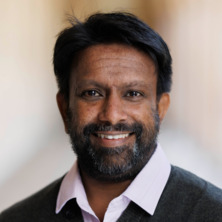
Shakes an imaging expert that leads a strong deep learning, artificial intelligence (AI) focused research team interested in medical image analysis and signal/image processing applied to many areas of science and medicine. He received his Ph.D in Theoretical Physics from Monash University, Melbourne and has been involved in applying machine learning in medical imaging for over a decade.
Shakes’ past work has involved developing shape model-based algorithms for knee, hip and shoulder joint segmentation that is being developed and deployed as a product on the Siemens syngo.via platform. More recent work involves deep learning based algorithms for semantic segmentation and manifold learning of imaging data. Broadly, he is interested in understanding and developing the mathematical basis of imaging, image analysis algorithms and physical systems. He has developed algorithms that utilise exotic mathematical structures such as fractals, turbulence, group theoretic concepts and number theory in the image processing approaches that he has developed.
He is currently a Senior Lecturer and leads a team of 20+ researchers working image analysis and AI research across healthcare and medicine. He currently teaches the computer science courses Theory of Computation and Pattern Recognition and Analysis.
Availability
- Dr Shakes Chandra is:
- Available for supervision
Fields of research
Qualifications
- Doctor of Philosophy, Monash University
Research interests
-
Magnetic Resonance Imaging
Making MRI faster and more affordable through better image reconstruction, processing and analysis.
-
Image Processing
Image reconstruction, segmentation and registration.
-
Deep learning
Dimensionality reduction, machine learning and Artificial Intelligence
-
Fractals and Chaos
Applying fractals and chaos to image processing and computer science.
-
Number Theory
Applying number theory to image processing and computer science.
-
Medical Image Analysis
Medical image segmentation and shape analysis
Works
Search Professor Shakes Chandra’s works on UQ eSpace
2012
Conference Publication
Unilateral hip joint segmentation with shape priors learned from missing data
Chandra, Shekhar, Xia, Yinq, Engstrom, Craig, Schwarz, Raphael, Lauer, Lars, Crozier, Stuart, Salvado, Olivier and Fripp, Jurgen (2012). Unilateral hip joint segmentation with shape priors learned from missing data. 9th IEEE International Symposium on Biomedical Imaging (ISBI), Barcelona, Spain, 2-5 March 2012. Piscataway, NJ, United States: IEEE. doi: 10.1109/ISBI.2012.6235909
2011
Conference Publication
Fast automatic multi-atlas segmentation of the prostate from 3D MR images
Dowling, Jason A., Fripp, Jurgen, Chandra, Shekhar, Pluim, Josien P. W., Lambert, Jonathan, Parker, Joel, Denham, James, Greer, Peter B. and Salvado, Olivier (2011). Fast automatic multi-atlas segmentation of the prostate from 3D MR images. 14th International Conference on Medical Image Computing and Computer-Assisted Intervention (MICCAI 2011), Toronto, Canada, 18-22 September 2011. Heidelberg, Germany: Springer. doi: 10.1007/978-3-642-23944-1_2
2011
Conference Publication
Automatic segmentation of the prostate in 3D magnetic resonance images using case specific deformable models
Chandra, Shekhar, Dowling, Jason, Shen, Kaikai, Pluim, Josien, Greer, Peter, Salvado, Olivier and Fripp, Jurgen (2011). Automatic segmentation of the prostate in 3D magnetic resonance images using case specific deformable models. International Conference on Digital Image Computing: Techniques and Applications, DICTA 2011, Noosa Heads, Qld., Australia, 6-8 December 2011. Piscataway, NJ, United States: I E E E. doi: 10.1109/DICTA.2011.10
2011
Conference Publication
Automated MR hip bone segmentation
Xia, Ying, Chandra, Shakes, Salvado, Olivier, Fripp, Jurgen, Schwarz, Raphael, Lauer, Lars, Engstrom, Craig and Crozier, Stuart (2011). Automated MR hip bone segmentation. International Conference on Digital Image Computing Techniques and Applications (DICTA), Noosa, QLD, Australia, 6-8 December 2011. Piscataway, NJ, United States: IEEE. doi: 10.1109/DICTA.2011.13
2011
Conference Publication
Growth of Discrete Projection Ghosts Created by Iteration
Svalbe, Imants and Chandra, Shekhar (2011). Growth of Discrete Projection Ghosts Created by Iteration. 16th International Conference on Discrete Geometry for Computer Imagery, Nancy France, 6 - 8 April 2011. Heidelberg, Germany: Springer. doi: 10.1007/978-3-642-19867-0_34
2010
Conference Publication
On constructing minimal ghosts
Svalbe, Imants, Nazareth, Nikesh, Chandra, Shekhar and Normand, Nicolas (2010). On constructing minimal ghosts. International Conference on Digital Image Computing: Techniques and Applications, DICTA 2010, Sydney, NSW Australia, 01 - 03 December 2010. Piscataway, NJ United States: I E E E. doi: 10.1109/DICTA.2010.56
2010
Other Outputs
Circulant theory of the Radon transform
Chandra, Shekhar Suresh (2010). Circulant theory of the Radon transform. PhD Thesis, Faculty of Science, School of Physics, Monash University.
2009
Conference Publication
A fast number theoretic finite radon transform
Chandra, S. and Svalbe, I. (2009). A fast number theoretic finite radon transform. Digital Image Computing: Techniques and Applications, DICTA 2009, Melbourne, VIC Australia, 1 - 3 December 2009. Piscataway, NJ United States: I E E E. doi: 10.1109/DICTA.2009.67
2008
Conference Publication
A method for removing cyclic artefacts in discrete tomography using latin squares
Chandra, Shekhar and Svalbe, Imants (2008). A method for removing cyclic artefacts in discrete tomography using latin squares. 19th International Conference on Pattern Recognition (ICPR 2008), Tampa, Fl United States, 8 - 11 Dec 2008. Washington, DC United States: I E E E Computer Society. doi: 10.1109/ICPR.2008.4761615
2008
Conference Publication
An exact, non-iterative Mojette inversion technique utilising ghosts
Chandra, Shekhar, Svalbe, Imants and Guedon, Jean-Pierre (2008). An exact, non-iterative Mojette inversion technique utilising ghosts. 14th International Conference on Discrete Geometry for Computer Imagery, Lyon, France, 16 - 18 April 2008. Heidelberg, Germany: Springer. doi: 10.1007/978-3-540-79126-3_36
2006
Journal Article
Quantised angular momentum vectors and projection angle distributions for discrete radon transformations
Svalbe, Imants, Chandra, Shekhar, Kingston, Andrew and Guedon, Jean-Pierre (2006). Quantised angular momentum vectors and projection angle distributions for discrete radon transformations. Discrete Geometry for Computer Imagery, Proceedings, 4245, 134-145.
2006
Conference Publication
Quantised angular momentum vectors and projection angle distributions for discrete radon transformations
Svalbe, Imants, Chandra, Shekhar, Kingston, Andrew and Guédon, Jean-Pierre (2006). Quantised angular momentum vectors and projection angle distributions for discrete radon transformations. 13th International Conference on Discrete Geometry for Computer Imagery, DGCI 2006, , , October 25, 2006-October 27, 2006. Springer Verlag. doi: 10.1007/11907350_12
Funding
Current funding
Past funding
Supervision
Availability
- Dr Shakes Chandra is:
- Available for supervision
Looking for a supervisor? Read our advice on how to choose a supervisor.
Available projects
-
Next generation magnetic resonance imaging MRI through vision
Summary: Magnetic resonance imaging (MRI) is crucial for diagnosing diseases within the human body. In this project, we develop new AI methods that leverage human visual perception to make MRI faster and more affordable.
Technologies such as magnetic resonance imaging (MRI) are essential in healthcare for non-invasively seeing inside the human body for disease diagnosis and assessment. However, imaging cost for MRI is so prohibitive that it is seldom used unless there is no other option despite its effectiveness. The cost is largely because MRI is a slow imaging modality compared to other options that do not provide as much information and soft tissue contrast needed to detect diseases such as cancer. Although some progress has been made to improve acquisition speed, all current methods do not make any allowances for the way that human experts read and understand regions of interest. A reduction in scan time will make MRI cheaper and therefore allow the technology to be more readily utilised in the future.
This project aims to create new artificial intelligence (AI) models and unify them with MRI acquisition directly in its measurement domain, helping us explain such models and create acquisitions more akin to human vision that only acquires the areas an operator needs, thereby reducing scan times.
Supervision history
Current supervision
-
Doctor Philosophy
Novel deep learning approaches to understanding human diseases
Principal Advisor
Other advisors: Associate Professor Craig Engstrom, Emeritus Professor Stuart Crozier
-
Doctor Philosophy
Magnetic Resonance Image Processing with Artificial Intelligence
Principal Advisor
Other advisors: Associate Professor Craig Engstrom, Dr Hongfu Sun
-
Master Philosophy
Multimodal Longitudinal Manifold Learning for Interpretable Disease Progression Modelling
Principal Advisor
-
Doctor Philosophy
Next generation magnetic resonance imaging (MRI) through vision
Principal Advisor
-
Doctor Philosophy
Foundational models for visual recognition
Principal Advisor
Other advisors: Associate Professor Craig Engstrom, Emeritus Professor Stuart Crozier
-
Doctor Philosophy
AI in the detection and diagnosis of preclinical and early osteoarthritis
Principal Advisor
Other advisors: Associate Professor Craig Engstrom, Dr Kieran O'Brien
-
Doctor Philosophy
Manifold Learning for Magnetic Resonance Imaging
Principal Advisor
Other advisors: Associate Professor Craig Engstrom, Emeritus Professor Stuart Crozier
-
Doctor Philosophy
Using 3D total body imaging to study the spatial distribution of naevi and melanoma
Associate Advisor
Other advisors: Professor Peter Soyer, Professor Monika Janda
-
Doctor Philosophy
Neonatal brain MRI of very preterm infants for prediction of neurodevelopmental outcomes
Associate Advisor
Other advisors: Dr Kerstin Pannek
-
Doctor Philosophy
MRI and image processing techniques for quantitative kidney imaging
Associate Advisor
Other advisors: Dr Nyoman Kurniawan
-
Doctor Philosophy
Establishment of a National Anterior Cruciate Ligament (ACL) Registry in Australia
Associate Advisor
Other advisors: Associate Professor Craig Engstrom
Completed supervision
-
2025
Doctor Philosophy
Improving Feature Extraction and Feature Interpretability for Deep Learning in Medical Image Analysis
Principal Advisor
Other advisors: Associate Professor Craig Engstrom, Emeritus Professor Stuart Crozier
-
2025
Doctor Philosophy
Medical Shape Analysis of 3D MRI Segmentation with Deep Learning
Principal Advisor
Other advisors: Emeritus Professor Stuart Crozier
-
2025
Doctor Philosophy
Automated Detection and Classification of Suspicious Naevi in Dermoscopy Images Through Artificial Intelligence
Principal Advisor
Other advisors: Professor Peter Soyer, Professor Monika Janda
-
2024
Doctor Philosophy
Deployable and Interpretable Deep Learning Architectures: Navigating Clinical Challenges in Medical Image Segmentation
Principal Advisor
Other advisors: Associate Professor Craig Engstrom, Emeritus Professor Stuart Crozier
-
2024
Doctor Philosophy
Towards Analysis of Contextual Melanoma Indicators and Identification of Total-Body Ugly Duckling Lesions with Deep Neural Networks
Principal Advisor
Other advisors: Associate Professor Mahsa Baktashmotlagh
-
2024
Doctor Philosophy
Deep Learning Strategies for Enhanced mTBI Diagnosis using Clinical and CT Data
Principal Advisor
Other advisors: Dr Viktor Vegh
-
2024
Doctor Philosophy
Efficient Image Representations for Compressed Sensing MRI
Principal Advisor
Other advisors: Associate Professor Craig Engstrom, Professor Feng Liu, Professor Markus Barth
-
2023
Doctor Philosophy
Towards Efficient Graph Neural Networks for Optimizing Illicit Dark Web Interventions
Principal Advisor
Other advisors: Professor Marius Portmann
-
2022
Doctor Philosophy
Automated Assessment of Cartilage Composition and Cam Morphology using Magnetic Resonance Images of the Hip Joint
Principal Advisor
Other advisors: Associate Professor Craig Engstrom, Emeritus Professor Stuart Crozier
-
2020
Doctor Philosophy
Computer aided lesion detection, segmentation and characterization on mammography and breast MRI
Principal Advisor
Other advisors: Emeritus Professor Stuart Crozier
-
2026
Doctor Philosophy
Sleep Fragmentation and its Daytime Outcomes in Obstructive Sleep Apnea Patients
Associate Advisor
Other advisors: Professor Juha Toyras, Associate Professor Philip Terrill
-
2026
Doctor Philosophy
Deep Learning Methods Towards Reliable and Physiology-Aligned Sleep Scoring
Associate Advisor
Other advisors: Professor Juha Toyras, Associate Professor Philip Terrill
-
2025
Doctor Philosophy
3D Imaging and Deep Learning for Phenotyping Sorghum at Canopy Scale
Associate Advisor
Other advisors: Professor Scott Chapman
-
2025
Doctor Philosophy
Advanced Deep Learning Approaches for Improving Diagnosis and Prognosis in Brain Disease
Associate Advisor
Other advisors: Professor Fatima Nasrallah
-
2023
Doctor Philosophy
In vitro evaluation of porous PHBV-based scaffolds for tissue regeneration application
Associate Advisor
Other advisors: Associate Professor Mingyuan Lu
-
2022
Doctor Philosophy
Improving deep learning-based fast MRI with pre-acquired image guidance
Associate Advisor
Other advisors: Emeritus Professor Stuart Crozier, Professor Feng Liu
Media
Enquiries
For media enquiries about Dr Shakes Chandra's areas of expertise, story ideas and help finding experts, contact our Media team: