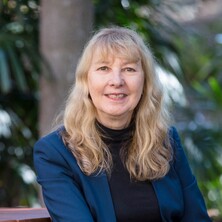
Professor Emerita Jennifer Corrin researches on law reform and development in plural legal regimes and legal issues affecting small states. She is a former Australian Research Council Future Fellow and in 2019 was a short-term Visiting Fellow at Jesus College, Oxford. Professor Emerita Corrin has participated in a number of research grant projects including an ARC Discovery Grant, which investigated means of better managing the flow of public finances and people across Australia's international borders; and work on environmental issues in Solomon Islands, funded by the MacArthur Foundation. Most recently she has been co-investigator in a project concerning inclusion of women’s voices in marine resource management in the Pacific, funded by the Arts and Humanities Research Council (UK). Jennifer has been consulted as an expert in a number of legal cases.
Professor Emerita Jennifer Corrin has published in the areas of legal pluralism, comparative law, South Pacific law, customary law, human rights, court systems, evidence, civil procedure, family law, land law, constitutional law and contract. She is the author of Contract Law in the South Pacific and co-author of Introduction to South Pacific Law (heading for its 5th edition), Courts and Civil Procedure in the South Pacific and Proving Customary Law in the Common Law Courts of the South Pacific. In 2019, she co-edited and wrote several chapters in a book on adoption in plural legal regimes. Her latest publication is the co-edited book, Legal Systems of the Pacific: Introducing Sixteen Gems.
Before joining The University of Queensland, Professor Emerita Corrin spent six years at the University of the South Pacific, having joined the Faculty after nine years in her own legal firm in Solomon Islands. She retains strong links with the profession and is a life member of Solomon Islands Bar Association. Professor Emerita Corrin’s memberships include the Australian Academy of Law, the Board of the Commission on Legal Pluralism, the Executive Committee of the Australian Law Academics Association, and titular membership of the International Academy of Comparative Law. She is a member of the Editorial Board of the Journal of Legal Pluralism, a member of the International Editorial Board of the Journal of South Pacific Law, and a member of the Editorial Board of the Comparative Law Journal and of the Asia Pacific Journal of Environmental Law.
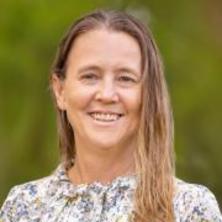
Chris is a social scientist specialising in international development. Her research primarily revolves around resilience and adaptation, with a current focus on agriculture policy and implementation. With a wealth of experience from her previous roles in international development and academia, Chris also brings strong expertise in monitoring and evaluation.
She has designed and led both research for development (R4D) and development projects across Cambodia, Vietnam, Solomon Islands, Kiribati, Tuvalu, Vanuatu, and Fiji. Her applied research aims to understand the processes and mechanisms of change that bridge policy and action, enhancing food security and sustainability. Currently, Chris is working on projects that emphasise agriculture policy and knowledge brokering for Environmental and Human Health (One Health) in Cambodia, building on her previous work in climate resilience, adaptation, and agrarian change in the region.
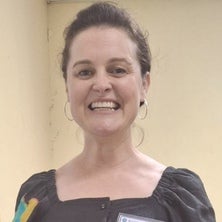
Karen is a Professor of Development Geography in the School of the Environment and an ARC Industry Laureate Fellow (2026–2031). Her work examines how people experience and respond to the intersecting challenges of climate change, disaster risk, poverty, and displacement. Over the past two decades, she has led long-term, collaborative research partnerships across the Asia-Pacific, working with governments, NGOs, and local communities to understand lived experiences of vulnerability, resilience, and adaptation.
Karen’s research has included supporting farming communities in Aceh rebuilding after the 2004 Indian Ocean tsunami; examining the experiences of newly settled migrants in Dhaka displaced by erosion and flooding; partnering with Torres Strait Elders to record traditional environmental knowledge; and documenting everyday climate impacts and adaptation stories across rural Pacific Island communities.
She has led a series of major research projects, including an ARC Future Fellowship, and has served in advisory roles for national governments and international organisations. She currently sits on the Expert Group on Non‑Economic Losses under the Warsaw International Mechanism for Loss and Damage (UNFCCC), contributing her expertise on climate-related impacts and social equity.
Karen grew up in Quirindi on Kamilaroi Country in NSW. Her rural upbringing fostered a deep commitment to research that is grounded, community-focused, and centred on supporting more just and resilient futures.
I work in medical anthropology and critical global health in Indonesia and Fiji. Funded by the Australian Research Council, I am currently researching obstetrics and childbirth experiences in Indonesian maternity care settings. This project is conducted with Dr Els Rieke (Universitas Papua), Associate Professor Najmah (Universitas Sriwijaya), Dr Elan Lazuardi (Universitas Gadjah Mada), with further support from Dr John Wantania and Dr Grace Korompis (Sam Ratulangi University). We are looking at diverse experiences in North Sulawesi, West Papua, South Sumatra, and Central Java.
I also value recent collaborations with researchers at the National University of Singapore (Associate Professor Shefaly Shorey, Alice Lee Centre for Nursing Studies) and Fiji National University focused on maternity care. In 2026, I will begin working with collaborators in Fiji on community-based ethnographic research on maternity care and cultural difference, supported by an ARC Future Fellowship. This involves ethnographic research in health settings in Fiji, looking at interactions and cultural norms to understand local ideals and practices of respectful care.
Prior to this I have worked closely with West Papuan and other international researchers on studies of maternity care and hospital experiences, older women's life stories, and HIV/AIDS. I completed a study with Dr Els Tieneke Rieke and Meki Wetipo on how urban Papuans understand and experience hospital childbirth, as part of an effort to understand dire maternal health conditions in this location (2023, The Asia Pacific Journal of Anthropology). This was published in a special issue on 'Reproducing Life in Conditions of Abandonment in Oceania', I edited with Alexandra Widmer (York University, Canada).
Other recent publications look at competing ideas of respectful maternity care in Singapore, gender inequality in Indonesia's frontier economy, older Papuan women’s narratives of economic agency and survivance (co-authored with Yohana Baransano), and the challenges faced by Indonesian newlyweds. My article in Asian Studies Review, "West Papuan ‘Housewives’ with HIV: Gender, Marriage, and Inequality in Indonesia," was awarded the 2025 Wang Gungwu Prize by the Asian Studies Association of Australia (ASAA).
I am an experienced PhD supervisor in medical anthropology and welcome research students who wish to conduct anthropological research in Indonesia or the Pacific Islands, especially in medical anthropology and hospital ethnography. My teaching experience includes undergraduate and postgraduate courses in medical anthropology (ANTH2250/7250), Pacific anthropology (ANTH2020) and gender (SOCY2050). I also enjoy contributing to Oceania journal as an associate editor.
I am an urban sociologist and an expert in urban community in all its forms. My research encompasses the outer suburbs in Australia, the gentrifying inner city and informal communities in cities in the Global South. My work focuses on how different urban places and spatial logic in the city impact our opportunities to form attachments to neighbourhoods and each other.
Internationally, I have written extensively on urban poverty in Bangladesh, India and Indonesia and I am currently involved in work on climate change and its effects on the urban poor in collaboration with colleagues in Indonesia, Brazil and Solomon Islands. My latest research concerns the impact of climate change and natural disasters on the urban poor. More than 1 billion people live in informal urban settlements or slums. These people are among the most vulnerable to the impact of climate change. However, adaptation and mitigation policies are being formulated at multiple scales, often without considering the voices of the poor.
I am the Bachelor of Arts Sociology program convenor and an award-winning teacher. I teach courses at all levels in our undergraduate sociology program, including Introduction to Sociology (SOCY1050), An Urban World (SOCY2340) and Advanced Studies in Social Thought: Getting the Big Picture (SOCY3345).
I am also an award-winning photographer (you can see some of my work on my Flickr page.
I am open to proposals from potential Honours and PhD students who share my passion for understanding the social life of cities. Whether you're from Australia, the Global South, or anywhere else in the world, I look forward to the possibility of working together.