
Overview
Background
Fully funded PhD Scholarship is currently available: https://study.uq.edu.au/study-options/phd-mphil-professional-doctorate/projects/unsteady-turbulence-dynamics-pulsatile-pipe-flow
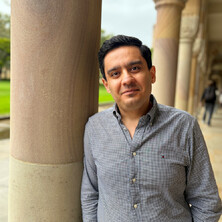
Dr Navid Freidoonimehr is a Lecturer in Mechanical Engineering within the School of Mechanical and Mining Engineering at The University of Queensland and an ARC Discovery Early Career Researcher Award (DECRA) Fellow. He completed his PhD at the University of Adelaide in 2021. His research spans biofluid mechanics, cardiovascular haemodynamics, and unsteady/pulsatile flow, with an emphasis on translating engineering insight into clinically meaningful cardiovascular diagnostics.
Navid Freidoonimehr’s research sits at the interface of engineering and clinical practice, with a strong focus on coronary artery physiology. His work integrates computational modelling (e.g., CFD and haemodynamic/diagnostic indices) with experimental fluid mechanics (benchtop flow loops, pressure–flow measurements, and flow visualisation) to quantify how lesions and microvascular resistance shape coronary physiology and how these effects can be captured with improved diagnostic approaches.
Alongside his cardiovascular program, Dr Freidoonimehr leads a DECRA project inspired by human heart pulsation that investigates how controlled flow pulsation can reduce energy consumption in pipelines, aiming to develop practical strategies for more efficient fluid transport in engineered systems. Before joining The University of Queensland, he held research and fellowship positions at the University of Adelaide, as a postdoctoral researcher (2021-2024), and Queensland University of Technology, as a Heart Foundation Postdoctoral Fellow (2024-2025).
Availability
- Dr Navid Freidoonimehr is:
- Available for supervision
Fields of research
Qualifications
- Bachelor of Mechanical Engineering, Bu-Ali Sina University
- Masters (Coursework) of Mechanical Engineering, Bu-Ali Sina University
- Doctor of Philosophy of Mechanical Engineering, University of Adelaide
Research interests
-
Cardiovascular biofluid mechanics
Understanding blood flow in the cardiovascular system is essential for improving diagnosis and treatment of coronary artery disease. This research investigates coronary haemodynamics in diseased arteries, with emphasis on coronary stenosis (including tandem lesions) and microvascular dysfunction/spasm. The work integrates experimental flow-loop studies with computational modelling to develop clinically meaningful physiological and diagnostic insights.
-
Pulsatile and unsteady flow
Many natural and engineered systems operate under unsteady or pulsatile conditions, where flow acceleration and phase effects can change losses and transport mechanisms. This research studies pulsatile flow physics using theory, experiments and numerical modelling. Applications range from coronary haemodynamics to engineered fluid systems where pulsation can be leveraged to improve performance.
-
Computational and experimental fluid dynamics
Developing robust models and measurements is central to translating fluid dynamics research into impact. This research focuses on combining computational fluid dynamics, reduced-order modelling, and laboratory experiments to quantify complex flows, validate mechanisms, and generate interpretable metrics that support decision-making in biomedical applications.
Research impacts
My research aims to create practical, clinically relevant tools that help improve cardiovascular diagnosis and patient management, especially in conditions where standard measures can be unreliable or incomplete (e.g., microvascular dysfunction/spasm and tandem coronary stenoses).
How it makes a difference:
- Better diagnostic interpretation: I develop hydrodynamic and resistance-based approaches to quantify coronary microvascular behaviour during provocative spasm testing, supporting clearer assessment of vasomotor dysfunction.
- Improved decision-making for complex lesions: My work on tandem stenoses helps clarify how physiology indices (e.g., pressure-based measures) can be affected by lesion interaction and microvascular resistance, information that can guide intervention strategy and reduce uncertainty.
- Translation through clinician–engineer collaboration: My projects are embedded in interdisciplinary teams with cardiology collaborators, enabling research questions and outputs to stay aligned with real clinical workflows and constraints.
Works
Search Professor Navid Freidoonimehr’s works on UQ eSpace
2015
Journal Article
Predictor homotopy analysis method for nanofluid flow through expanding or contracting gaps with permeable walls
Freidoonimehr, Navid, Rostami, Behnam and Rashidi, Mohammad Mehdi (2015). Predictor homotopy analysis method for nanofluid flow through expanding or contracting gaps with permeable walls. International Journal of Biomathematics, 8 (4) 1550050. doi: 10.1142/S1793524515500503
2015
Journal Article
Analysis of entropy generation in an MHD flow over a rotating porous disk with variable physical properties
Rashidi, Mohammad Mehdi, Mahmud, Shohel, Freidoonimehr, Navid and Rostami, Behnam (2015). Analysis of entropy generation in an MHD flow over a rotating porous disk with variable physical properties. International Journal of Exergy, 16 (4), 481-503. doi: 10.1504/IJEX.2015.069110
2015
Journal Article
Dual solutions for MHD Jeffery-Hamel nano-fluid flow in non-parallel walls using Predictor Homotopy Analysis Method
Freidoonimehr, N. and Rashidi, M. M. (2015). Dual solutions for MHD Jeffery-Hamel nano-fluid flow in non-parallel walls using Predictor Homotopy Analysis Method. Journal of Applied Fluid Mechanics, 8 (4), 911-919. doi: 10.18869/acadpub.jafm.67.223.23941
2015
Journal Article
Unsteady MHD free convective flow past a permeable stretching vertical surface in a nano-fluid
Freidoonimehr, Navid, Rashidi, Mohammad Mehdi and Mahmud, Shohel (2015). Unsteady MHD free convective flow past a permeable stretching vertical surface in a nano-fluid. International Journal of Thermal Sciences, 87, 136-145. doi: 10.1016/j.ijthermalsci.2014.08.009
2014
Journal Article
Double diffusive magnetohydrodynamic (MHD) mixed convective slip flow along a radiating moving vertical flat plate with convective boundary condition
Rashidi, Mohammad M., Kavyani, Neda, Abelman, Shirley, Uddin, Mohammed J. and Freidoonimehr, Navid (2014). Double diffusive magnetohydrodynamic (MHD) mixed convective slip flow along a radiating moving vertical flat plate with convective boundary condition. PLoS ONE, 9 (10) e109404. doi: 10.1371/journal.pone.0109404
2014
Journal Article
Analysis of entropy generation in MHD stagnation-point flow in porous media with heat transfer
Rashidi, M. M. and Freidoonimehr, N. (2014). Analysis of entropy generation in MHD stagnation-point flow in porous media with heat transfer. International Journal for Computational Methods in Engineering Science and Mechanics, 15 (4), 345-355. doi: 10.1080/15502287.2014.915248
2014
Journal Article
Mixed convective heat transfer for MHD viscoelastic fluid flow over a porous wedge with thermal radiation
Rashidi, M. M., Ali, M., Freidoonimehr, N., Rostami, B. and Hossain, M. Anwar (2014). Mixed convective heat transfer for MHD viscoelastic fluid flow over a porous wedge with thermal radiation. Advances in Mechanical Engineering, 2014 735939, 735939. doi: 10.1155/2014/735939
2014
Journal Article
Homotopy simulation of nanofluid dynamics from a non-linearly stretching isothermal permeable sheet with transpiration
Rashidi, M. M., Freidoonimehr, N., Hosseini, A., Bég, O. Anwar and Hung, T. K. (2014). Homotopy simulation of nanofluid dynamics from a non-linearly stretching isothermal permeable sheet with transpiration. Meccanica, 49 (2), 469-482. doi: 10.1007/s11012-013-9805-9
2014
Journal Article
Analytical investigation of laminar viscoelastic fluid flow over a wedge in the presence of buoyancy force effects
Rostami, B., Rashidi, M. M., Rostami, P., Momoniat, E. and Freidoonimehr, N. (2014). Analytical investigation of laminar viscoelastic fluid flow over a wedge in the presence of buoyancy force effects. Abstract and Applied Analysis, 2014 496254. doi: 10.1155/2014/496254
2014
Journal Article
Comparative numerical study of single and two-phase models of nanofluid heat transfer in wavy channel
Rashidi, M. M., Hosseini, A., Pop, I., Kumar, S. and Freidoonimehr, N. (2014). Comparative numerical study of single and two-phase models of nanofluid heat transfer in wavy channel. Applied Mathematics and Mechanics (English Edition), 35 (7), 831-848. doi: 10.1007/s10483-014-1839-9
2014
Journal Article
Entropy analysis for an unsteady MHD flow past a stretching permeable surface in nano-fluid
Abolbashari, Mohammad Hossein, Freidoonimehr, Navid, Nazari, Foad and Rashidi, Mohammad Mehdi (2014). Entropy analysis for an unsteady MHD flow past a stretching permeable surface in nano-fluid. Powder Technology, 267, 256-267. doi: 10.1016/j.powtec.2014.07.028
2014
Journal Article
First and second-law efficiency analysis and ANN prediction of a diesel cycle with internal irreversibility, variable specific heats, heat loss, and friction considerations
Rashidi, M. M., Hajipour, A., Mousapour, A., Ali, M., Xie, Gongnan and Freidoonimehr, N. (2014). First and second-law efficiency analysis and ANN prediction of a diesel cycle with internal irreversibility, variable specific heats, heat loss, and friction considerations. Advances in Mechanical Engineering, 2014 359872, 359872. doi: 10.1155/2014/359872
2014
Journal Article
Analytical modelling of three-dimensional squeezing nanofluid flow in a rotating channel on a lower stretching porous wall
Freidoonimehr, Navid, Rostami, Behnam, Rashidi, Mohammad Mehdi and Momoniat, Ebrahim (2014). Analytical modelling of three-dimensional squeezing nanofluid flow in a rotating channel on a lower stretching porous wall. Mathematical Problems in Engineering, 2014 (1) 692728. doi: 10.1155/2014/692728
2014
Journal Article
Free convective heat and mass transfer for MHD fluid flow over a permeable vertical stretching sheet in the presence of the radiation and buoyancy effects
Rashidi, Mohammad Mehdi, Rostami, Behnam, Freidoonimehr, Navid and Abbasbandy, Saeid (2014). Free convective heat and mass transfer for MHD fluid flow over a permeable vertical stretching sheet in the presence of the radiation and buoyancy effects. Ain Shams Engineering Journal, 5 (3), 901-912. doi: 10.1016/j.asej.2014.02.007
2013
Journal Article
Parametric analysis and optimization of entropy generation in unsteady MHD flow over a stretching rotating disk using artificial neural network and particle swarm optimization algorithm
Rashidi, M. M., Ali, M., Freidoonimehr, N. and Nazari, F. (2013). Parametric analysis and optimization of entropy generation in unsteady MHD flow over a stretching rotating disk using artificial neural network and particle swarm optimization algorithm. Energy, 55, 497-510. doi: 10.1016/j.energy.2013.01.036
2013
Journal Article
Entropy generation in steady MHD flow due to a rotating porous disk in a nanofluid
Rashidi, M. M., Abelman, S. and Mehr, N. Freidooni (2013). Entropy generation in steady MHD flow due to a rotating porous disk in a nanofluid. International Journal of Heat and Mass Transfer, 62 (1), 515-525. doi: 10.1016/j.ijheatmasstransfer.2013.03.004
Supervision
Availability
- Dr Navid Freidoonimehr is:
- Available for supervision
Looking for a supervisor? Read our advice on how to choose a supervisor.
Available projects
-
Unsteady turbulence dynamics in pulsatile pipe flow
A fully funded PhD scholarship is available for a domestic student to undertake research in experimental fluid mechanics, with a focus on the physics of turbulent pulsatile pipe flow.
Supervision history
Current supervision
-
Doctor Philosophy
FUNCTIONAL INVESTIGATION OF CORONARY ARTERIES WITH TANDEM LESIONS
Principal Advisor
Media
Enquiries
For media enquiries about Dr Navid Freidoonimehr's areas of expertise, story ideas and help finding experts, contact our Media team: