
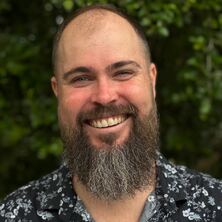
Overview
Availability
- Dr Tobias Smith is:
- Available for supervision
Qualifications
- Doctor of Philosophy, The University of Queensland
Works
Search Professor Tobias Smith’s works on UQ eSpace
2022
Journal Article
How is trehalulose formed by Australian stingless bees? - An intermolecular displacement of nectar sucrose
Zhang, Jiali, Hungerford, Natasha L., Yates, Hans S.A., Smith, Tobias J. and Fletcher, Mary T. (2022). How is trehalulose formed by Australian stingless bees? - An intermolecular displacement of nectar sucrose. Journal of Agricultural and Food Chemistry, 70 (21), 6530-6539. doi: 10.1021/acs.jafc.2c01732
2021
Book
Optimising bioactive content of Australian stingless bee honey
Fletcher, Mary, Hungerford, Natasha and Smith, Tobias (2021). Optimising bioactive content of Australian stingless bee honey. Wagga Wagga, NSW Australia: AgriFutures Australia.
2021
Journal Article
The effect of protective covers on pollinator health and pollination service delivery
Kendall, Liam K., Evans, Lisa J., Gee, Megan, Smith, Tobias J., Gagic, Vesna, Lobaton, Juan D., Hall, Mark A., Jones, Jeremy, Kirkland, Lindsay, Saunders, Manu E., Sonter, Carolyn, Cutting, Brian T., Parks, Sophie, Hogendoorn, Katja, Spurr, Cameron, Gracie, Alistair, Simpson, Melinda and Rader, Romina (2021). The effect of protective covers on pollinator health and pollination service delivery. Agriculture, Ecosystems and Environment, 319 107556, 107556. doi: 10.1016/j.agee.2021.107556
2021
Journal Article
Phenotypic differentiation among native, expansive and introduced populations influences invasion success
Lázaro‐Lobo, Adrián, Moles, Angela T., Fried, Guillaume, Verloove, Filip, Antonio Campos, Juan, Herrera, Mercedes, Goñi, Elena, Bioret, Fréderic, Buffa, Gabriella, Fantinato, Edy, Sentinella, Alexander, Zalucki, Myron P., Mayfield, Margaret, Smith, Tobias, Catling, Alexandra, Zalucki, Jacinta M., Lucardi, Rima D., Shoemaker, Cory M., Mason, David S. and Ervin, Gary N. (2021). Phenotypic differentiation among native, expansive and introduced populations influences invasion success. Journal of Biogeography, 48 (11), 2907-2918. doi: 10.1111/jbi.14252
2021
Journal Article
Feeding sugars to stingless bees: identifying the origin of trehalulose-rich honey composition
Hungerford, Natasha L., Zhang, Jiali, Smith, Tobias J., Yates, Hans S. A., Chowdhury, Sadia A., Carter, James F., Carpinelli de Jesus, Matheus and Fletcher, Mary T. (2021). Feeding sugars to stingless bees: identifying the origin of trehalulose-rich honey composition. Journal of Agricultural and Food Chemistry, 69 (35) acs.jafc.1c02859, 10292-10300. doi: 10.1021/acs.jafc.1c02859
2021
Conference Publication
Stingless bees produce honey rich in the beneficial disaccharide, trehalulose
Hungerford, Natasha L., Zhang, Jiali, Smith, Tobias J., Carpinelli de Jesus, Matheus, Yates, Hans S. A., Chowdhury, Sadia A., Carter, James F., Webber, Dennis, Stone, Isobella S. J., Blanchfield, Joanne T., Zawawi, Norhasnida, Schirra, Horst J., Tran, Trong D. and Fletcher, Mary T. (2021). Stingless bees produce honey rich in the beneficial disaccharide, trehalulose. Symposium of Research & Innovation for Food (SoRIF), Universiti Teknologi MARA, Malaysia via WebEX, 23-24 June 2021.
2021
Journal Article
Pollen diets and niche overlap of honey bees and native bees in protected areas
Elliott, Brittany, Wilson, Rachele, Shapcott, Alison, Keller, Alexander, Newis, Ryan, Cannizzaro, Chris, Burwell, Chris, Smith, Tobias, Leonhardt, Sara D., Kämper, Wiebke and Wallace, Helen M. (2021). Pollen diets and niche overlap of honey bees and native bees in protected areas. Basic and Applied Ecology, 50, 169-180. doi: 10.1016/j.baae.2020.12.002
2021
Conference Publication
Stingless Bee Honey’s unique properties
Hungerford, Natasha L., Zhang, Jiali, Smith, Tobias J., Carpinelli de Jesus, Matheus, Yates, Hans S. A., Chowdhury, Sadia A., Carter, James F., Webber, Dennis, Stone, Isobella S. J., Blanchfield, Joanne T., Zawawi, Norhasnida and Fletcher, Mary T. (2021). Stingless Bee Honey’s unique properties. Australian Apitherapy Association Global Conference 2021, Online, 26-27 November 2021.
2020
Journal Article
Landscape simplification modifies trap-nesting bee and wasp communities in the subtropics
Wilson, Rachele S., Leonhardt, Sara D., Burwell, Chris J., Fuller, Chris, Smith, Tobias J., Kaluza, Benjamin F. and Wallace, Helen M. (2020). Landscape simplification modifies trap-nesting bee and wasp communities in the subtropics. Insects, 11 (12) 853, 1-15. doi: 10.3390/insects11120853
2020
Journal Article
Evidence for male genitalia detachment and female mate choice in the Australian stingless bee Tetragonula carbonaria
Smith, T. J. (2020). Evidence for male genitalia detachment and female mate choice in the Australian stingless bee Tetragonula carbonaria. Insectes Sociaux, 67 (1), 189-193. doi: 10.1007/s00040-019-00744-6
2020
Other Outputs
Stingless bee fighting
Hereward, James, Smith, Tobias and Lau, Ieng Hou (2020). Stingless bee fighting. The University of Queensland. (Dataset) doi: 10.14264/0592ecf
2018
Journal Article
Seedling growth responses to species-, neighborhood-, and landscape-scale effects during tropical forest restoration
Charles, Lachlan S., Dwyer, John M., Smith, Tobias J., Connors, Sophie, Marschner, Petra and Mayfield, Margaret M. (2018). Seedling growth responses to species-, neighborhood-, and landscape-scale effects during tropical forest restoration. Ecosphere, 9 (8) e02386, e02386. doi: 10.1002/ecs2.2386
2018
Journal Article
The effect of habitat fragmentation on the bee visitor assemblages of three Australian tropical rainforest tree species
Smith, Tobias J. and Mayfield, Margaret M. (2018). The effect of habitat fragmentation on the bee visitor assemblages of three Australian tropical rainforest tree species. Ecology and Evolution, 8 (16), 8204-8216. doi: 10.1002/ece3.4339
2018
Journal Article
Bee conservation: Key role of managed bees
Saunders, Manu E., Smith, Tobias J. and Rader, Romina (2018). Bee conservation: Key role of managed bees. Science, 360 (6387), 389-389. doi: 10.1126/science.aat1535
2017
Journal Article
Species wood density and the location of planted seedlings drive early-stage seedling survival during tropical forest restoration
Charles, Lachlan S., Dwyer, John M., Smith, Tobias J., Connors, Sophie, Marschner, Petra and Mayfield, Margaret M. (2017). Species wood density and the location of planted seedlings drive early-stage seedling survival during tropical forest restoration. Journal of Applied Ecology, 55 (2), 1009-1018. doi: 10.1111/1365-2664.13031
2016
Journal Article
Honey bees: the queens of mass media, despite minority rule among insect pollinators
Smith, Tobias J. and Saunders, Manu E. (2016). Honey bees: the queens of mass media, despite minority rule among insect pollinators. Insect Conservation and Diversity, 9 (5), 384-390. doi: 10.1111/icad.12178
2015
Journal Article
Diptera species and functional diversity across tropical Australian countryside landscapes
Smith, Tobias J. and Mayfield, Margaret M. (2015). Diptera species and functional diversity across tropical Australian countryside landscapes. Biological Conservation, 191, 436-443. doi: 10.1016/j.biocon.2015.07.035
2014
Other Outputs
The taxonomic and functional diversity of bees and flies in Australian tropical countryside landscapes
Smith, Tobias (2014). The taxonomic and functional diversity of bees and flies in Australian tropical countryside landscapes. PhD Thesis, School of Biological Sciences, The University of Queensland.
2014
Journal Article
Pollination and floral ecology
Smith, Tobias (2014). Pollination and floral ecology. Austral Ecology, 39 (4), e6-e7. doi: 10.1111/aec.12139
Supervision
Availability
- Dr Tobias Smith is:
- Available for supervision
Looking for a supervisor? Read our advice on how to choose a supervisor.
Supervision history
Current supervision
-
Doctor Philosophy
Biocultural relationships and Indigenous People'sstewardship of Native stingless bee habitats
Associate Advisor
Other advisors: Dr James Hereward, Mr Jim Walker, Dr Coen Hird
Media
Enquiries
For media enquiries about Dr Tobias Smith's areas of expertise, story ideas and help finding experts, contact our Media team: