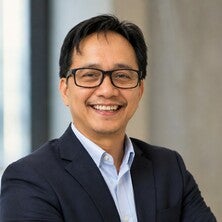
Dr Anthony Halog: Expert in Circular Economy, Life Cycle Thinking, and Sustainable Systems
Dr. Anthony B. Halog is a professor at the University of Queensland specialising in circular economy, sustainability engineering, industrial ecology, and life cycle assessment (LCA/LCSA). His current work focuses on designing low-carbon, net-zero, and resource-efficient systems to address climate change, waste reduction, and sustainable development.
Dr. Halog works across energy, materials, food, waste, and policy systems, applying systems thinking, life cycle sustainability assessment, digital twins, and artificial intelligence for sustainability. His research helps governments, industries, and communities make evidence-based decisions that reduce emissions, improve resource efficiency, and avoid unintended environmental impacts.
A core focus of his work is transforming linear value chains into circular value chains, supporting green hydrogen, bioenergy, circular bioeconomy, agricultural waste valorisation, waste-to-energy, and sustainable materials. These solutions contribute to decarbonisation, climate resilience, sustainable supply chains, and the green economy.
Key areas of expertise
Circular economy and industrial ecology
Life cycle assessment and sustainability metrics
Green hydrogen, bioenergy, and clean energy transitions
Sustainable waste management and circular bioeconomy
Systems modelling, AI-enabled tools, and sustainability policy
Dr. Halog collaborates with policymakers, industry partners, SMEs, and Indigenous communities in Australia and internationally to deliver practical climate solutions and support the transition to decarbonised circular economies.
Affiliate of Centre for Biodiversity and Conservation Science
Centre for Biodiversity and Conservation Science
Faculty of Science
Associate Professor
School of the Environment
Faculty of Science
Availability:
Available for supervision
Media expert
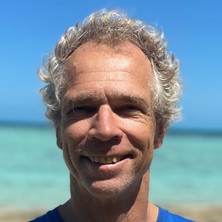
Research interest: Monitoring ecosystem health of coral reefs and seagrass habitats, integrating field and remote sensing image datasets, and the developing applied cost-effective mapping and monitoring approaches. Developed approaches have been adopted as standard practice globally, making a difference in conservation of these valuable habitats. The long term monitoring studies at Heron and Moreton Bay formed the basis for the development of mapping and monitoring over time and space at local to global scale. See here major research impact
Major projects:
Long term monitoring of benthic composition at Heron Reef (2002-ongoing).
Long term monitoring of seagrass composition and abundance in Moreton bay Marine Park (2000-ongoing).
Smart Sat CRC Hyperspectral Remote Sensing of Seagrass and Coral Reefs 2023-2027.
Developement of Underwater Field Spectrometry and Benthic Photo Collection and Analysis
3D GBR Habitat Mapping Project 2015 - ongoing:
Global habitat mapping project 2019-2023 Allen Coral Atlas .
Current position: Associate Professior in Marine Remote Sensing leading the Marine Ecosystem Monitoring Lab. . Academic Director Heron Island Research Station and affiliated researchers with Centre for Marine Science and Centre for Biodiversity and Conservation Science
Capacity Building and Citizen Science: Capacity: under/post graduate courses; Msc/PhD supervision, workshops/courses; Remote Sensing Educational Toolkit, and online courses (e.g. TNC).Strong supporter of citizen science based projects, as trainer, organiser and advisor for Reef Check Australia, CoralWatch, Great Reef Census and UniDive.