Affiliate of Centre for Public, International and Comparative Law
Centre for Public, International and Comparative Law
Faculty of Business, Economics and Law
Professor
School of Law
Faculty of Business, Economics and Law
Availability:
Not available for supervision
Media expert
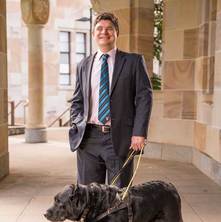
Professor Paul Harpur OAM is a leading international and comparative disability rights legal academic, and a leader in higher education reforms.
Professor Harpur directs the the UQ Disability Collaboratory. The UQ Disability Collaboratory is a university-wide University of Queensland initiative which galvanises the university’s significant but currently distributed research expertise in order to maximise research impact and output. The Collaboratory is the primary means by which UQ enacts its commitment to research excellence in the fields of disability inclusion and was established following the University’s adoption of the Champions of Change Disability Inclusion Research and Innovation Plan. In addition to including a commitment to forming a high-impact disability research network, the Plan will further UQ’s leadership in disability inclusion research, ensuring that people with lived experience of disability play a central role in shaping research outcomes.
Beyond the UQ, Professor Harpur holds international posts, including as an Associate with the Harvard Law School's Harvard Project on Disability, an International Distinguished Fellow, with the Burton Blatt Institute, Syracuse University, Berkeley Center on Comparative Equality and Anti-Discrimination Law, and is a former Fulbright Future Scholar.
Professor Harpur is active in university-wide and sector-wide higher education change. Illustratively he has chairred the UQ Disability Inclusion Group since 2016 and sits on a range of university-wide committees. At the sector-wide level, during 2023 Dr Harpur served on the Ministerial Reference Group for the Universities Accord. He also serves on the Higher Education Standards Panel (HESP), which is a statutory body under Part 9 of the Tertiary Education Quality and Standards Agency Act 2011 (Cth). The HESP is charged to advise and make recommendations to the Minister and to the Tertiary Education Quality and Standards Agency (TEQSA) on the Higher Education Standards Framework and to TEQSA on matters including TEQSA’ strategic objectives, corporate plan, performance against that plan, reform agenda, streamlining of activities and resourcing requirements and its regulatory approaches. He also serves on the Advisory Board for the Australian Centre for Student Equity and Success, formerly the National Center for Student Equity in Higher Education. In April the Univertas 21 (U21) Senior Leaders Group adopted the U21 Framework for Equitable and Inclusive Global Engagement to guide EDI across the 30 university Network. This Framework as a committee, the U21 EDI Management Committee, to which Professor Harpur was appointed in 2025. His transformational work and service has been recognised with numerous diversity and inclusion, human resources and leadership citations and awards. In the 2024 Australia Day Honours, Professor Harpur was awarded a Medal of the Order of Australia by the Governor General of Australia (OAM). The citation for his OAM is “for service to people with disability”.
Additionally, Professor Harpur is a former Fulbright Future Scholar, former current Australian Research Council Future Fellow, and duel Paralympian. He competed in the Sydney 2000 Paralympics and the Athens 2004 Paralympics and has the Paralympics Australia Pin #614.
Professor Harpur is a TEDx speaker (“Universities as Disability Champions of Change”).
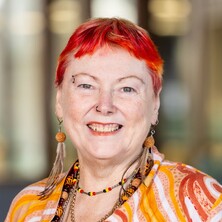
I am a Saltwater woman and a descendant of Matora (Awabakal) and Bungaree (Garigal/Darug), with family ties through Diana Mudgee to the Wiradyuri Nation. I am an Associate Professor in the UQ Business School and Director of the Indigenous Business Hub, and serve as Associate PRME Director – Indigenous Engagement for the UQ Business School.
I have more than 40 years of experience across academia, government, industry and community, with professional and academic work spanning Indigenous employment, Indigenous business, equity and inclusion, organisational change, industrial relations and Indigenous economic participation. My work brings together academic research, professional practice, community relationships and policy engagement, with a focus on creating practical and sustainable pathways for Aboriginal and Torres Strait Islander peoples, organisations and businesses.
My research centres on Indigenous employment, Indigenous business, Indigenous leadership and organisational transformation. My scholarship examines how colonial structures, institutional practices and workplace systems shape the experiences and opportunities of Aboriginal and Torres Strait Islander peoples. Drawing on Indigenous standpoint theory, Indigenous methodologies, Indigenous feminist perspectives and decolonial approaches, my research develops relational and culturally grounded approaches to employment, leadership, business and organisational change.
My research program spans industrial relations, human resource management, business education, leadership, Indigenous governance and economic participation. A consistent feature of my work is the connection between research, policy and practice. My research has informed policy processes and has been cited in Ministerial papers and Bills introduced into Parliament. I have also contributed to national policy and advisory processes concerning Indigenous employment, higher education, Indigenous entrepreneurship, workforce participation and organisational change.
As Director of the Indigenous Business Hub, I connect research, education, industry and community. The Hub supports research and engagement with Aboriginal and Torres Strait Islander businesses, organisations, governments and communities, and provides pathways for Indigenous knowledge, business expertise and community priorities to inform business education and research at UQ.
I established the International Journal of Indigenous Business through the Indigenous Business Hub and serve as Editor-in-Chief. The journal provides an international scholarly platform for Indigenous business research and centres Indigenous voices, Indigenous knowledges and priorities across business, enterprise, governance, policy, education and leadership.
I completed my Doctor of Philosophy (Business) at the University of Newcastle in 2016. My doctoral thesis, Private-sector employment programs for Aboriginal and Torres Strait Islander peoples: Comparative case studies, examined approaches to Indigenous employment in the private sector. I was the first Aboriginal person to be awarded a PhD in Business from the University of Newcastle.
I completed my Honours thesis in 2006, examining mentoring as a human resource strategy to address labour market disadvantage for Indigenous Australians through a qualitative study of mentoring outcomes for Indigenous trainees at the University of Newcastle.
My work is grounded in reciprocity, relational accountability and Indigenous self-determination. Across academic, community, industry and policy settings, I seek to create opportunities through which knowledge, relationships and resources can move in both directions — strengthening UQ while contributing to outcomes for Aboriginal and Torres Strait Islander communities, businesses, organisations and students.
Emma Olssen is a Koori Aboriginal woman from the Wiradjuri Nation of New South Wales through her mother and grandparents, and a Middle-Eastern Australian through her father's lineage. Born in Muloobinba (Newcastle, NSW), she grew up in Winnam (Wynnum) on Quandamooka Country (Moreton Bay).
Emma has an extensive professional background in leadership, executive management, organisational change, and Indigenous engagement across diverse sectors. As an Indigenous researcher, her work is grounded in Indigenous methodologies and explores the experiences of Aboriginal and Torres Strait Islander employees across identified and non-identified roles.
Her research examines how organisational structures, workplace cultures, and employment practices shape Indigenous employees' experiences of inclusion, wellbeing, leadership, and career progression. Through qualitative yarning, her work challenges assumptions that representation alone leads to meaningful inclusion and highlights the organisational conditions that enable Aboriginal and Torres Strait Islander peoples to thrive in the workplace. Her research contributes to contemporary discussions on Indigenous employment, equity, and organisational transformation.