
Overview
Background
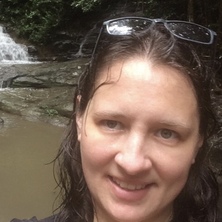
Lorna Hernandez Santin is a restoration ecologist whose research focuses on understanding, monitoring, and improving ecosystem recovery and biodiversity outcomes following disturbance. Her work integrates restoration ecology, fauna ecology, conservation biology, environmental monitoring, remote sensing, and spatial analysis to support evidence-based restoration and nature-positive outcomes.
As Acting Group Leader of the Ecosystem & Biodiversity Group within the Centre for Environmental Responsibility in Mining, Lorna contributes to research that assesses mining impacts on flora and fauna, develops approaches to restore ecosystem services, supports recolonisation by native species, and improves the long-term sustainability of disturbed landscapes. See the group’s website for more information: [smi.uq.edu.au].
Lorna collaborates with industry, government, and research partners to improve how restoration success is defined, measured, and achieved. Her research supports the application of the mitigation hierarchy and adaptive management, helping organisations avoid and minimise impacts, implement effective restoration strategies, and evaluate ecological recovery using robust monitoring approaches. This work aims to improve biodiversity outcomes throughout the mine life cycle, from project planning and impact mitigation to rehabilitation, mine closure, and post-closure recovery. Her research also explores the use of emerging technologies, including drone- and satellite-based remote sensing, hyperspectral imaging, and automated species detection, to improve environmental monitoring and restoration assessment.
Current research interests include:
- Mine rehabilitation and ecological restoration
- Fauna ecology and biodiversity conservation
- Restoration assessment and ecosystem recovery trajectories
- Restoration frameworks, standards, targets, and completion criteria
- Ecological indicators and monitoring frameworks
- Environmental monitoring using field-based methods and remote sensing technologies, including imagery collected from drones, aircraft, and satellites using RGB, multispectral, and hyperspectral sensors
- Species detection, habitat assessment, and spatial modelling using remote sensing approaches
- Landscape ecology and spatial analysis
- Evidence-based approaches to mine closure and environmental management
Her broader research experience includes wildlife ecology, conservation biology, habitat suitability modelling, species distributions, movement ecology, and biodiversity monitoring across Australia and the Americas.
Availability
- Dr Lorna Hernandez Santin is:
- Available for supervision
Fields of research
Qualifications
- Bachelor (Honours) of Biology, Universidad de las Américas, Puebla
- Masters (Research) of Natural Resources Management, Sul Ross State University
- Doctor of Philosophy of Ecology, The University of Queensland
Research impacts
Lorna's research advances understanding of how ecosystems recover following disturbance and how restoration outcomes can be improved for biodiversity, ecosystem function, and long-term landscape sustainability. Her work addresses knowledge gaps in restoration ecology, fauna conservation, environmental monitoring, and mine rehabilitation, while generating evidence that supports more informed environmental decision-making.
Through collaborations with industry, government, and research organisations, Lorna has contributed to the development of approaches that improve the planning, monitoring, assessment, and communication of environmental outcomes. Her research helps bridge the gap between ecological theory and on-ground implementation, supporting adaptive management and evidence-based restoration practices.
Examples of the impacts of her research include:
- Improving understanding of ecosystem recovery trajectories and the factors influencing restoration success.
- Advancing approaches for assessing biodiversity outcomes, including flora, fauna, and ecosystem function.
- Supporting the development of restoration frameworks, monitoring programs, and assessment methodologies.
- Improving communication of environmental information between scientists, industry, regulators, and other stakeholders.
- Informing decisions related to rehabilitation planning, environmental management, mine closure, and landscape recovery.
By integrating ecological field studies, remote sensing technologies, and spatial analysis, Lorna's research contributes to more effective restoration strategies and environmental management outcomes across disturbed landscapes.
Works
Search Professor Lorna Hernandez Santin’s works on UQ eSpace
2008
Other Outputs
Mesocarnivore richness and relative distribution along riparian areas of Big Bend National Park
Hernandez-Santin, Lorna (2008). Mesocarnivore richness and relative distribution along riparian areas of Big Bend National Park. Alpine, TX, United States: Lorna Hernandez-Santin.
2007
Other Outputs
Movements and range sizes of jaguars in Paraguay, based on GPS-telemetry
Hernandez-Santin, Lorna (2007). Movements and range sizes of jaguars in Paraguay, based on GPS-telemetry. M.Sc Thesis, School of Agricultural and Natural Resource Sciences, Sul Ross State University.
2007
Journal Article
Ecological characterization of the avifauna of the urban parks of the City of Puebla (México)
González Oreja, José Antonio, Bonache Regidor, Carolina, Buzo Franco, Daniela, De La Fuente Díaz Ordaz, Arturo Andrés and Hernández Satín, Lorna (2007). Ecological characterization of the avifauna of the urban parks of the City of Puebla (México). Ardeola, 54 (1), 53-67.
2004
Other Outputs
Dinámica espacial y temporal de la comunidad de aves en los parques urbanos de Puebla y su entorno
Buzo Franco, Daniela and Hernandez Santin, Lorna (2004). Dinámica espacial y temporal de la comunidad de aves en los parques urbanos de Puebla y su entorno. B.Sc Thesis, Escuela de Ciencias, Departamento de Quimica y Biologia.
Funding
Current funding
Past funding
Supervision
Availability
- Dr Lorna Hernandez Santin is:
- Available for supervision
Looking for a supervisor? Read our advice on how to choose a supervisor.
Supervision history
Current supervision
-
Master Philosophy
Non-Invasive Abundance Monitoring of Captive Mala (Lagorchestes hirsutus) Using Proximal Remote Sensing
Principal Advisor
Other advisors: Associate Professor Diana Fisher, Dr Alina Bialkowski
-
Doctor Philosophy
Harnessing hyperspectral and structural data for species identification and vegetation monitoring of rehabilitated mined lands
Principal Advisor
Other advisors: Professor Peter Erskine, Dr Phill McKenna
-
Doctor Philosophy
What informs a trajectory towards when restoring a socioecological system?
Associate Advisor
Other advisors: Associate Professor Sarah Holcombe, Professor Peter Erskine
-
Master Philosophy
Mammal conservation and ecological refuges in FarNorth Queensland
Associate Advisor
Other advisors: Professor Hugh Possingham, Associate Professor Diana Fisher
Media
Enquiries
For media enquiries about Dr Lorna Hernandez Santin's areas of expertise, story ideas and help finding experts, contact our Media team: