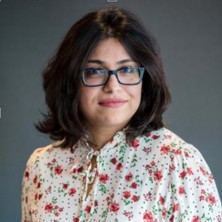
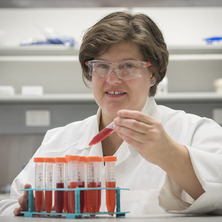
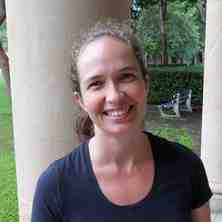
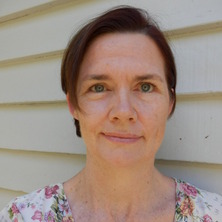
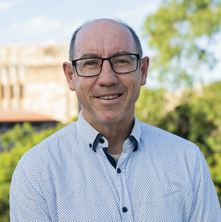
United Nations (UN) member states in 2015 agreed to 17 global Sustainable Development Goals (SDGs) to end poverty, protect the planet and ensure prosperity for all. Dr Deirdre Mikkelsen is a microbiologist and Senior Lecturer in Food Science at the School of Agriculture and Food Sustainability, where her teaching and research contribute to several UN SDGs, including:
Goal 2 – Zero Hunger
Goal 3 – Good Health and Well-being
Goal 4 – Quality Education
Goal 12 – Responsible Consumption and Production
Goal 13 – Climate Action
Goal 15 – Life on Land
Deirdre holds a B.Sc. (First Class Honours, 1999) and a PhD in Microbiology (2005), both from UQ. She has expertise in molecular microbial ecology, bioinformatics and fermentation microbiology. Her academic journey includes research roles at the Advanced Wastewater Management Centre (2005) and from 2006 at the Centre for Nutrition and Food Sciences (CNAFS), Queensland Alliance for Agriculture and Food Innovation (QAAFI), where she held Postdoctoral and Research Fellow positions. She joined her current School in 2019.
Program Coordination and Teaching
Dr Deirdre Mikkelsen is the Program Coordinator for the following postgraduate programs:
Master of Food Science and Technology
Master of Food Science and Technology (Research Extensive)
Graduate Certificate in Food Science and Technology
She also coordinates and teaches:
FOOD2000 – Food Science
FOOD3017 – Food Safety & Quality Management
FOOD7021 – Professional Experience (Work Integrated Learning)
Professional Memberships and Engagement
Member, Australian Institute of Food Science and Technology (AIFST) – Queensland Branch Committee
Member, International Union of Food Science and Technology (IUFoST) Education Oversight Group – Australasia representative
Member, IUFoST – Food Safety Working Committee 2.2 (Education focus)
Academic Advisory Group Member, Ag Connections Agriskills Accelerator Program
Affiliate of Centre for Innovation in Pain and Health Research (CIPHeR)
Centre for Innovation in Pain and Health Research
Faculty of Health, Medicine and Behavioural Sciences
Affiliate of Centre for Marine Science
Centre for Marine Science
Faculty of Science
Professor
School of Veterinary Science
Faculty of Science
Availability:
Available for supervision
Media expert
Veterinary pharmacology and therapeutics, with special interest in transdermal drug delivery, pulmonary therapeutics and the control of inflammation. An additional interest includes wildlife ecology and therapeutics.
Paul Mills graduated from UQ School of Veterinary Science in 1987 and, after a period in clinical practice, completed a PhD investigating pharmacological control of inflammation in racing animals. He undertook a 3 year postdoctoral position at The Animal health Trust in the United Kingdom and established the Oxidative Stress research group. He was also the team veterinarian on a study of heat and humidity in horses towards the Atlanta Olympic Games. He returned to Australia and undertook positions as a NHMRC Senior Research Officer at the Princess Alexandria Hospital and as a Senior Government Veterinary Officer with Racing Queensland.
A/Prof Mills re-joined the School of Veterinary Science in 2001 and established the Pharmacology Research Unit to focus research into veterinary pharmacology. He was also a co-founder of Veterinary Marine Animal Research, Teaching and Investigation (Vet-MARTI; http://www.uq.edu.au/vetschool/vet-marti) in 2008. He has attracted over $2 million in research funding during this time and is the author on more than 100 peer-reviewed scientific publications. A/Prof Mills is a member (by examination) of the Australian College of Veterinary Scientists for Veterinary Pharmacology and an external reviewer for the Australian Pesticides and Veterinary Medicines Authority. He currently teaches veterinary pharmacology and anatomy, receiving UQ and ALTC awards and funding for teaching innovations.
Affiliate Associate Professor of Queensland Alliance for Agriculture and Food Innovation
Queensland Alliance for Agriculture and Food Innovation
Discipline Lead - Crop Science of School of Agriculture and Food Sustainability
School of Agriculture and Food Sustainability
Faculty of Science
Professor
School of Agriculture and Food Sustainability
Faculty of Science
Availability:
Available for supervision
Media expert
Professor Jaquie Mitchell's activities are focused around two core themes.Jaquie has worked on various Research for Development (R4D) projects based in South-East Asia with the aim of improving productivity and livelihoods of smallholder farmers. Currently she leads two R4D projects one focused on developing an integrated weed management package for mechanised and broadcast lowland crop production systems in Laos and Cambodia. While the other is a first of its kind, public private partnership between ACIAR and a private agribusiness company, aiming to establish a highly productive, sustainable, traceable, quality-assured value chain for rice in the Mekong Delta, Vietnam, benefiting rice-farming households and meeting the market requirements of SunRice’s established global customers.
The second research theme includes examining genetic variation for resistance to abiotic stress, such as high and low-temperature tolerance at the reproductive stage in rice, the advantage of reduced-tillering gene in wheat grown under terminal drought, the effect of salinity and water-deficit on production of volatile compounds in aromatic rice. In close collaboration with the Australian rice industry, Jaquie currently leads two AgriFutures funded pre-breeding projects aimed to improve lodging resistance, cold tolerance and aerobic adaptation for high water productivity rice. In addition to exploring genetic variation in physiological traits and genomic regions of importance to improved water productivity, genomic tools are under development to improve breeding efficiency for the Riverina. Based at The University of Queensland, School of Agriculture and Food Sustainability, Jaquie provides specialist guidance and assistance to undergraduate and postgraduate research students within crop physiology and agronomy with extensive experience conducting research projects focused on abiotic stress, pre-breeding and rice cropping systems research.
Postdoctoral Research Fellow - Sustainability Assessment
Queensland Alliance for Agriculture and Food Innovation
Availability:
Available for supervision
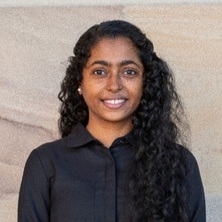
Dr Cresha Gracy Nadar is a Postdoctoral Research Fellow at the Centre for Crop Science, Queensland Alliance for Agriculture and Food Innovation (QAAFI), The University of Queensland. Her work sits at the interface of biotechnology, bioprocess engineering, and sustainability assessment, advancing solutions for a more resilient and low-carbon agri-food future.
Cresha’s research focuses on emerging biotechnologies; ongoing projects include precision fermentation for alternative food proteins, plant tissue culture for sustainable propagation, and seaweed valorisation for functional ingredients. She combines process modelling, life-cycle assessment (LCA) and techno-economic analysis (TEA) to evaluate the environmental and economic performance of innovative biomanufacturing systems.
Her PhD, jointly awarded by IIT Bombay (India) and Monash University (Australia), developed an integrated fruit waste biorefinery and assessed its sustainability through LCA and TEA. At UQ, she continues to bridge engineering realism with sustainability metrics, collaborating with academic and industry partners to translate laboratory innovations into scalable, commercially viable, and environmentally responsible technologies.
Postdoctoral Research Platform Fellow - Metabolomic Specialist
Australian Institute for Bioengineering and Nanotechnology
Availability:
Available for supervision
My field of expertise is biochemistry and metabolism of dietary phytonutrients and plant toxins. I graduated at the Justus-Liebig University Giessen, Germany (Master and PhD) before I joined QAAFI in April 2011. In both, Master and PhD thesis I was focusing on bioactivity and bioavailability of polyphenols. I continued working in this area initially in a professional role before moving into a postdoctoral position to explore the area of metabolism of plant toxins in cattle in particular indospicine, an arginine analogue which is predominantly found in a legume called Indigofera and which is one of the main fodder for cattle in the arid regions of central Australia. In 2016 I have been awarded an Advance Queensland Postdoctoral Fellowship to investigate the potential development of a ruminal inoculum against the detrimental effects of indospicine.
Queensland Alliance for Agriculture and Food Innovation
Availability:
Available for supervision
Dr Loan Nguyen is an applied genomics researcher focused on discovering genomic insights and translating them into practical tools for sustainable agriculture and livestock production. Her expertise integrates long-read sequencing, genome assembly, transcriptomics, molecular biology, bioinformatics and animal science.
Her pioneering contributions include developing an epigenetic clock for age prediction in cattle, and implementing portable sequencing for livestock traceability in Australia. She applies genomic approaches to address key challenges in agriculture, including genetic improvement, causative variant discovery, low-coverage sequencing, SNP array development and on-farm genomic decision-making.
Dr Nguyen’s achievements have been recognised through a prestigious ARC Industry Fellowship. Her work is advancing applied genomics to improve productivity, traceability, sustainability and food security in Australia and internationally.
Michael Noad graduated with a Bachelor of Veterinary Science from UQ in 1990. After working primarily as a small animal vet in Queensland and the UK, Mike returned to Australia to undertake a PhD in humpback whale acoustic behaviour at the University of Sydney in 1995. In 2002, after finishing his PhD, Mike became a postdoctoral fellow in the School of Integraitve Biology at UQ. In 2003 he was employed as a lecturer in the School of Veterinary Science. He is currently a professor at UQ, dividing his time between veterinary science, where he teaches anatomy, and marine science, the focus of his research. In 2019 he became the Academic Director of the Moreton Bay Research Station, and in 2022 the Director of the Centre for Marine Science while still retaining a substantive apointment in the School of Veterinary Science.
Research:
The key areas of Mike's research are the effects of anthopogenic underwater noise on whales, the evolution and function of humpback whale song, social learning and culture in animals, and marine mammal population ecology. With regards to the effects of anthropogenic underwater noise on whales, there is currently a great deal of concern about how anthropogenic noise such as military sonar, oil and gas exploration activity and commercial shipping traffic, may adversely affect marine mammals. Mike has been involved in several large collaborative projects in this area, the largest being BRAHSS where the team studied the behavioural changes of humpback whales in response to powerful seismic airguns. His work on the evolution and function of humpback whale song is focused on how the animals themselves use sound to communicate. The songs of these whales is one of the most complex acoustic displays of any animal known. The songs are not static, but constantly change, and although the songs are almost certainly used as a sexual signal, the changing nature of the song makes understanding how this works challenging. His work on social learning and culture in animals also involves humpback whale songs, but focuses on how the whales learn the songs from each other, both within and between populations. As the patterns are usually unique to a population but can be transmitted over time to other populations, humpback song is the most extreme example of a vocal cultural trait in any species as well as an excellent model for studying social learning, the process whereby the whales perceive and learn new songs. Mike's last research area is marine mammal population ecology, and the primary project is the population ecology of the east Australian humpback whales. This population was almost completely extirpated in the early 1960s through hunting, but has since undergone a rapid recovery. Its long term trajectory, however, is uncertain due to a number of factors including possibly overshooting the natural carrying capacity of the population, and climate change.
Nutritional Biochemistry, grazing and intensive production of cattle, sheep, goats.
My passion for agriculture and animal science comes from growing up amongst relatives in country Victoria, from Yea in the north, Korumburra in Gippsland and Heywood in the Western District. My career in agricultural science began at Melbourne University in 1960, with a defining year (1961) at Dookie Agricultural College, and subsequently with studies at The University of Sydney (1964-1969), University of New England (1970-72) and since 1973 at The University of Queensland. Promoted to Associate Professor in 1984, appointed Head of School of Agriculture in 1993 and the Head of School of Land and Food (1998-1999). Promotion to Professor was denied in 1997 and again in 2000. Retired from the University in 2006, but have maintained academic and research activity by managing ACIAR and other grants in Papua New Guinea and Vietnam. Publications since retirement have included books on family history, goat production in Vietnam and other biographies. Latest publications were on goat nutrition in 2022, in collaboration with Dr Simon Quigley's team at UQ, This year, 2023, celebrates 50 years of service to the University of Queensland.
Plant nutrition, specialising in tropical root crops.
Since joining the University of Queensland in 1992, Dr. O'Sullivan has completed a series of projects characterising deficiencies and toxicities of mineral nutrients, in species of sweetpotato, aroids and yams, and identifying and remediating nutritional disorders in semi-subsistence production contexts in collaboration with project partners in Pacific Island countries.
Chiara is Professor in Veterinary Pathology at the School of Veterinary Science (SVS) of the University of Queensland (UQ). She is a board certified specialist veterinary pathologist (Diplomate of the European College of Veterinary Pathology), graduated with a DVM from the University of Teramo (Italy) in 2002 and a PhD in Ultrastructural Pathology in 2006. Before joining UQ in 2012, she has been working as an Assistant Professor in Veterinary Pathology at the University of Teramo (Italy). She has a specific research interest is small animal oncology, in particular canine prostate cancer, and veterinary oncoepidemiology. She is Chair of the canine prostate cancer subgroup at the Oncology Pathology Working Group (OPWG), co-coordinator of the Global Initiative for Veterinary Cancer Surveillance (GIVCS) committee for the establishment of international standards of veterinary cancer registration and team leader of the comparative oncology theme of the Queensland Alliance of One Health Science. She is also member of the board of the Veterinary Cancer Guidelines and Protocols (VCGP) group, member of the Oncology Committee of the World Small Animal Veterinary Association (WSAVA) and chair of the ESVP/ECVP DEI task force. She is past President of the Australian Society for Veterinary Pathology and, within UQ SVS, she has been postgraduate coursework coordinator (2014-2017), HDR coordinator (2017-2019) and Director of Research (2019-2021). She is now coordinator of the UQ SVS veterinary pathology postgraduate training program. She has received several academic awards, including SVS awards for research excellence (2017, 2021), best lecturer (2021, 2022, 2023, 2024), and UQ award for excellence in HDR supervision (2020). She has published more than 120 papers on international journals, 3 book chapters and numerous abstracts in proceedings of national and international conferences. She has > 15 years expertise in veterinary diagnostic pathology, histopathology, IHC and TEM in multiple species. Since her first academic appointment in 2005, she mentored several postgraduate and undergraduate students in diagnostic investigation of animal cancer and research in canine oncology. Although outside the field of comparative oncology, she also a unique expertise in avian pathology and transmission electron microscopy.
Dr Taylor Pini is a lecturer in veterinary reproduction within the School of Veterinary Science and leads the Molecular Animal Reproductive Biology Lab (MARBL). Taylor's research focuses on understanding fundamental reproductive biology across species, in order to improve the outcomes of assisted reproductive technologies (ARTs) like artificial insemination for livestock and wildlife. Some recent examples of her research work include:
Exploring sperm formation and function in kangaroos
How cooling and freezing sperm impacts cellular 'clean up' machinery
Why frozen ram semen fails to get ewes pregnant
How the cellular makeup of sperm differs across the kingdom of life
Taylor graduated with a Bachelor of Animal and Veterinary Bioscience (Hons) and a PhD in reproductive biology from The University of Sydney. After her PhD, Taylor undertook postdocs at the Colorado Center for Reproductive Medicine (USA), and with the Gametic Epigenetics Consortium against Obesity (GECKO) at The University of Sydney, before beginning at UQ in 2021. Taylor has worked across many aspects of reproduction (from pregnancy detection to sperm freezing) in a range of species, including mice, humans, sheep, horses, koalas, kangaroos, parrots and echidnas.
Taylor is a co-host and producer of the science communication podcast Repro Radio.
Looking for a research project? Taylor is currently on parental leave, but will be taking on Summer and Winter Scholarship Students (undergraduate), Science Honours Students, Masters and PhD students in 2027.
Affiliate of ARC Training Centre for Bioplastics and Biocomposites
ARC Training Centre for Bioplastics and Biocomposites
Faculty of Engineering, Architecture and Information Technology
Centre Manager – ARC Industrial Transformation Training Centre for Bioplastics and Biocomposites
School of Chemical Engineering
Faculty of Engineering, Architecture and Information Technology
Availability:
Not available for supervision
I have a strong interest in applied research, using information to improve policy. I have a broad interest in applying population genetics to the management of wild populations, particularly through a better understanding of dispersal.
Queensland Alliance for Agriculture and Food Innovation
Availability:
Available for supervision
Professor Andries B. Potgieter is a Principal Research Fellow at the Queensland Alliance for Agriculture and Food Innovation (QAAFI), University of Queensland, and an international leader in Digital Agriculture. With a career spanning over 35 years across government, industry, and academia, his research integrates remote sensing, climate forecasting, and crop–climate modelling to support resilient, data-driven decision-making in agriculture. He is currently a key research collaborator in the $36 million GRDC-funded Analytics for the Australian Grains Industry (AAGI) initiative, where he leads digital analytics activities within UQ.
Professor Potgieter’s work focuses on developing predictive tools that combine satellite Earth observation, machine learning, and crop simulation to improve seasonal forecasting, crop monitoring, and risk management. He has pioneered widely adopted innovations such as the CropID tool, now commercialised via Data Farming Pty Ltd, and his models have influenced decision frameworks at Statistics Canada and the FAO. His 114 peer-reviewed publications have accrued over 4,000 citations, and his Field-Weighted Citation Impact (FWCI) places him in the top 5% of researchers globally.
He has built a thriving interdisciplinary research program and mentoring pipeline, supervising PhD, Masters, and MoDS students, and supporting postdoctoral researchers who now work at AWS, Sugar Research Australia, and the Chinese Academy of Agricultural Sciences. His leadership in global partnerships has positioned UQ as a preferred academic collaborator for international institutions tackling climate-smart agriculture.
Current projects
Analytics for the Australian Grains Industry (AAGI) – Digital analytics for yield forecasting and decision tools for grain growers (GRDC)
CropVision – Satellite remote sensing and AI for field-scale crop production forecasting (ARC Linkage)
RiskSSmart – Integration of Earth observation and climate models for sorghum risk mitigation (SmartSat CRC)
Root Phenomics – Linking above-ground sensing to root system architecture to accelerate phenotyping of drought-tolerant cereals (GRDC; Chief Investigator)
ARC Training Centre for Predictive Breeding in Agricultural Futures – Developing next-generation tools and training pathways for climate-resilient crop improvement (ARC Industrial Transformation Training Centres; Collaborating Investigator)
Previous research highlights
Late Maturity Alpha Amylase (LMA) Risk Modelling – National-scale risk prediction framework for wheat quality (GRDC)
CropPhen – High-throughput phenotyping for crop type and growth stage detection via drone/UAV (GRDC)
SIMLESA and YieldShield – Groundbreaking work in food insecurity mapping and climate risk insurance across eastern and southern Africa
Affiliate of Centre for Geoanalytical Mass Spectrometry
Centre for Geoanalytical Mass Spectrometry
Faculty of Science
Principal Research Fellow
Queensland Alliance for Agriculture and Food Innovation
Availability:
Available for supervision
Dr. Luis Prada e Silva is an Associate Professor at the Queensland Alliance for Agriculture and Food Innovation (QAAFI), University of Queensland, specialising in ruminant nutrition. His research focuses on unravelling the mechanisms behind feed efficiency in tropical cattle and improving maternal nutrition, attracting strong support from industry, private funders, and the scientific community. With experience across three of the world's major beef-producing countries, Brazil, Australia, and the United States, Luis brings a global perspective to his work. He previously held a position at the University of São Paulo, completed a sabbatical at AgriBio, Melbourne, and earned his PhD at Michigan State University, where he studied the nutritional and physiological modulation of ruminant development. Among his achievements are leading multiple research projects aimed at improving cattle production efficiency, publishing 59 peer-reviewed scientific articles and several book chapters, and supervising 8 PhD students and 18 Master's students. His research integrates cattle nutrition, physiological mechanisms, and genomic tools, contributing significantly to advancements in the field.
Faculty of Health, Medicine and Behavioural Sciences
Availability:
Available for supervision
Media expert
Simon Reid is a Professor in the School of Public Health at the University of Queensland. He is a keen advocate of One Health and the application of systems thinking approaches to understand and improve interventions for wicked zoonotic disease problems at the human-animal-ecosystem interface such as leptospirosis, brucellosis, human-bat interactions and antimicrobial resistance. His research focuses on understanding how to improve multisectoral governance, planning and implementation of responses to manage One Health problems. He delivers postgraduate courses in systems thinking, communicable disease control and One Health.
Faculty of Engineering, Architecture and Information Technology
Availability:
Not available for supervision
Marguerite Renouf BSc(Hons)/BA, PhD (Env Man) UQ is a Research Fellow at the School of Chemical Engineering's Water-Energy-Carbon Research Group (www.chemeng.uq.edu.au/water-energy-carbon).
She has worked in environmental research at UQ for 20 years, with a particular interest in the environmental evaluation of production systems and urban systems using environmental life cycle assessment (LCA), urban metabolism evaluation and eco-efficiency analysis. She is interested how we can produce and consume with less drain on the environment.
Since completing a PhD in 2011, she has driven a stream of research that evaluates the environmental performance of agri-based product supply chains and products (bio-fuels, bio-materials, food, beverages) using LCA. She has collaborated with industries and researchers in Australia and overseas to develop LCA tools for industry to support the identification of more environmentally-friendly production practices and processes.
Prior to this, her research was concerned with eco-efficiency in manufacturing industries (food processing, metal industries, retail and tourism sectors) and was a long-term contributor to UQ’s Working Group for Cleaner Production (now operating as the Eco-Efficienc Group), and its Director for three years (2009-2012).
Currently, Marguerite is a lead researcher with the CRC for Water Sensitive Cities, develop methods and metrics for quantifiying the water water-sensitive performance of Australian cities, using urban metabolism approaches. In this work she collaborates cloesely with urban planners, water manager and architects.
Affiliate of Centre for Biodiversity and Conservation Science
Centre for Biodiversity and Conservation Science
Faculty of Science
Professor
School of the Environment
Faculty of Science
Availability:
Available for supervision
Media expert
Professor Anthony J. Richardson uses mathematical, statistical, computational and spatial planning tools to investigate human impacts on our oceans - and to find solutions. Particular foci include:
Marine spatial planning - Where best to locate marine protected areas to minimise impacts on people, maximise ecosystem benefits, ensure they are climate-smart and connected, and enable multiple-use zoning of the ocean.
Developing models of marine ecosystems - How do lower trophic levels (plankton) regulate fisheries productivity and carbon sequestration, and how will these be impacted by climate change.
Long-term change in lower trophic levels (plankton) in the ocean. This includes both field work around Australia and global analyses.
Anthony did an undergradulate degree in Mathematics and Biology at the University of Queensland, followed by an Honours degree there. He was awarded a PhD degree from the University of Cape Town in 1998, modelling the dynamics of marine ecosystems. Since 2005, Anthony has held a joint position between UQ (School of the Environment) and CSIRO Environment. He has previously held positions at the University of Cape Town (South Africa), the University of the Western Cape (South Africa), and the Sir Alister Hardy Foundation of Ocean Science (UK).
Anthony runs a dynamic lab at the nexus between conservation science and mathematics. His focus is on using mathematical tools to better conserve biodiversity, predict impacts of climate change, and understand the functioning of marine ecosystems. If you have a background in marine ecology and are interested in applying mathematics/statistics/computational science and want to apply your skills to real-world problems, get in touch.