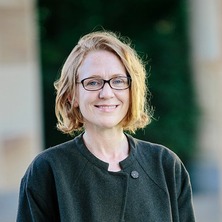
My research draws on sociological theories to examine how organizations and their leaders justify controversial practices, engage with stakeholders, and respond to scandals both rhetorically and with practical actions. This work falls under the theoretical umbrella of organizational legitimacy and helps understanding how business ethics practices evolve over time. Empirically, my areas of interest span a wide variety of contexts, from the emergence of responsible taxation to the implementation of ethics management systems, from the integration of Indigenous values in Western management thinking to the protection of not-for-profits from trust failures, and from the governance of sport organizations to the evolution of ESG reporting. My approach to research is quite eclectic, including qualitative, quantitative, and conceptual work, yet I rely primarily on qualitative methodologies: chiefly interviews, archival material. and observations. Conducting this type of research has taken me across many countries including, Australia, Europe, China, the US, and Madagascar. Ultimately my work is aimed at providing guidance on how organizations can keep pace with the evolution of societal norms and stakeholder expectations.
My work has published in a variety of top journals including Journal of Management Studies (on how corporate leaders respond and adapt to critique during crises), Journal of Business Ethics (on the successes and failures of ethics control systems), Accounting, Organizations and Society (on changes of stakeholder expectations with regards to corporate taxation). These and other pieces have received multiple international recognitions, among others the R. Edward Freeman Journal of Business Ethics Philosophy in Practice Best Paper, the Amartya Sen Essay Prize by Academics Stand Against Poverty, and the Academy of Management Carolyn Dexter Award.
In teaching, I am best known for delivering courses in critical thinking, ethics, philosophy, leadership, sustainability, anthropology, and for integrating Indigenous knowledge. My teaching experience spans across undergraduate and postgraduate levels, with a decade of involvement in MBA and executive education programs. My passion for teaching was recognised with the student-nominated 2024 Beta Gamma Sigma Academic of the Year Award.
Before joining UQ, I was lecturer and then senior lecturer at the School of Strategy, Innovation, and Technology at the University of Sydney Business School. Prior to academia, I spent a decade working in the sport event management industry as a consultant. I also worked at the United Nations Global Compact in New York focusing on sustainability and anti-corruption practices. and in my family business as taxation and labour consultant.
Affiliate of Centre for Public, International and Comparative Law
Centre for Public, International and Comparative Law
Faculty of Business, Economics and Law
Availability:
Available for supervision
Associate Professor Francesca Bartlett lectures in Ethics and the Legal Profession and Family Law. She is the Deputy Dean of the Law School. She is a Fellow of the Centre for Public, Comparative and International Law and researches in the area of lawyers' ethics and practice, access to justice and women and the law. She was a CI on the Australian Feminist Judgments Project funded by the Australian Research Council under a Discovery Project Grant. She is undertaking a number of projects relating to lawyers working across Australia including around family law and family violence, abuse of process and duty of competence, as well as legal professions in the Pacific. She has led a project concerning technology and access to justice in the legal assistance sector funded under an AIBE Applied Research Fund grant and was a CI on a project funded by the Queensland Law Society concerning disruption to and innovation by small law firms across Queensland. Francesca was a Visiting Fellow at the Centre on the Legal Profession at Stanford University in November 2018. She is the co-author (with Holmes) of textbook, Parker & Evans' Inside Legal Ethics in 2023 and forthcoming 2026. She also has an interest in clinical legal education and runs an international placement course funded by New Colombo Plan Mobility Grant funding.
She is a member of the Queensland Law Society Ethics Advsory Committee and is the Vice President of the International Association of Legal Ethics. Francesca is an Academic Member of the School's Pro Bono Centre Advisory Board, and has held a senior administrative position as Director of teaching and Learning in the Law School. Before joining the Law School, she practiced for a number of years as a commercial solicitor at a national law firm in Melbourne and Brisbane.
Affiliate of Centre for Public, International and Comparative Law
Centre for Public, International and Comparative Law
Faculty of Business, Economics and Law
Professor
School of Law
Faculty of Business, Economics and Law
Availability:
Available for supervision
Media expert
Dr Peter Billings is a Professor at the School of Law, The University of Queensland, Brisbane, and a Fellow of the Higher Education Academy. His research interests are in particular areas of public law: administrative law, immigration and refugee law, social welfare law and human rights law. In 2016 he received an Australian Award for University Teaching - Award for Programs that Enhance Learning (Pro Bono Centre). Since 2010 he has received five teaching excellence awards within the School of Law for outstanding course/teacher evaluations, and in 2011 was awarded the Vice Chancellor's Equity and Diversity Award (UQ) for the Asylum and Refugee Law Project.
Recent publications include: P Billings (ed), Regulating Refugee Protection through Social Welfare: Law, Policy and Praxis (Routledge, 2023); An Annotated Guide to the Human Rights Act 2019 (Qld) (LexisNexis, 2023) (with N Jones); Ch. 10 "Immunised and Indifferent to Indefinite Incarceration, in M Peterie, Immigration Detention and Social Harm: The Collateral Impacts of Migrant Incarceration (Routledge, 2025); and "Causing a Stir: Unwanted Aliens and the Cauldron of Crimmigration Controls Post NZYQ" (UQLJ (2025) forthcoming).
Queensland Alliance for Agriculture and Food Innovation
Higher Degree by Research Scholar
Queensland Alliance for Agriculture and Food Innovation
Availability:
Available for supervision
Media expert
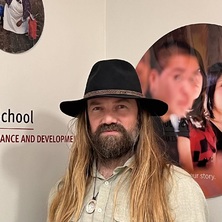
Jacob is a proud Gamilaraay man from QLD and a PhD candidate within QAAFI. Jacob's work focuses on Indigenous food sovereignty as nation-building, looking at the Gamilaraay peoples' governance of thier native grains industry as a case study.
Jacob is taking a systems approach in developing the nascent native grains industry. His priority is setting strong, strategic, sustainable, Indignoeus-led governace to ensure opportunity and benefit remains with Indigenous people. Jacob also has active interests spanning the ecology and conservaion of native grassland species; agronomic knowledge to help support reintroduction of native grains; supply chain and processing of native grains; nutrition and food safety; product development and marketing; and education and engagement.
Jacob's passion also extends to the broader Indigenous food sovereignty movement. Through his work, Jacob collaborates across disparate spaces and advocates for the transformative potential of integrated, circular, sustainable, Indigenous-designed food systems that prioritise human and ecosystem health over profit and production.
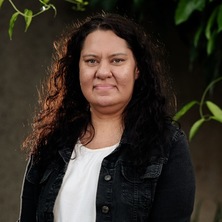
I am a Saltwater woman and a descendant of Matora (Awabakal) and Bungaree (Garigal/Darug), with family ties through Diana Mudgee to the Wiradyuri Nation. I am an Associate Professor in the UQ Business School and Director of the Indigenous Business Hub, and serve as Associate PRME Director – Indigenous Engagement for the UQ Business School.
I have more than 40 years of experience across academia, government, industry and community, with professional and academic work spanning Indigenous employment, Indigenous business, equity and inclusion, organisational change, industrial relations and Indigenous economic participation. My work brings together academic research, professional practice, community relationships and policy engagement, with a focus on creating practical and sustainable pathways for Aboriginal and Torres Strait Islander peoples, organisations and businesses.
My research centres on Indigenous employment, Indigenous business, Indigenous leadership and organisational transformation. My scholarship examines how colonial structures, institutional practices and workplace systems shape the experiences and opportunities of Aboriginal and Torres Strait Islander peoples. Drawing on Indigenous standpoint theory, Indigenous methodologies, Indigenous feminist perspectives and decolonial approaches, my research develops relational and culturally grounded approaches to employment, leadership, business and organisational change.
My research program spans industrial relations, human resource management, business education, leadership, Indigenous governance and economic participation. A consistent feature of my work is the connection between research, policy and practice. My research has informed policy processes and has been cited in Ministerial papers and Bills introduced into Parliament. I have also contributed to national policy and advisory processes concerning Indigenous employment, higher education, Indigenous entrepreneurship, workforce participation and organisational change.
As Director of the Indigenous Business Hub, I connect research, education, industry and community. The Hub supports research and engagement with Aboriginal and Torres Strait Islander businesses, organisations, governments and communities, and provides pathways for Indigenous knowledge, business expertise and community priorities to inform business education and research at UQ.
I established the International Journal of Indigenous Business through the Indigenous Business Hub and serve as Editor-in-Chief. The journal provides an international scholarly platform for Indigenous business research and centres Indigenous voices, Indigenous knowledges and priorities across business, enterprise, governance, policy, education and leadership.
I completed my Doctor of Philosophy (Business) at the University of Newcastle in 2016. My doctoral thesis, Private-sector employment programs for Aboriginal and Torres Strait Islander peoples: Comparative case studies, examined approaches to Indigenous employment in the private sector. I was the first Aboriginal person to be awarded a PhD in Business from the University of Newcastle.
I completed my Honours thesis in 2006, examining mentoring as a human resource strategy to address labour market disadvantage for Indigenous Australians through a qualitative study of mentoring outcomes for Indigenous trainees at the University of Newcastle.
My work is grounded in reciprocity, relational accountability and Indigenous self-determination. Across academic, community, industry and policy settings, I seek to create opportunities through which knowledge, relationships and resources can move in both directions — strengthening UQ while contributing to outcomes for Aboriginal and Torres Strait Islander communities, businesses, organisations and students.
Dr. Dani Linder is a Bundjalung, Kungarakany woman from Grafton, New South Wales, a public lawyer, and a Senior Lecturer in Law at the University of Queensland, Australia (UQ), where she teaches "Foundations of Law" and "Law and Indigenous Peoples". As an Indigenous legal academic, feminist, and advocate for constitutional reform and political empowerment of First Nations, her research interests include Indigenous self-determination and cultural identity, electoral law and policy reform, Indigenous political participation and representation, comparative constitutional law, and international human rights.
Dr. Linder is an admitted lawyer with a Bachelor of Laws degree, a Graduate Diploma in Legal Practice, a Master of Laws degree which specialises in Corporate and Commercial Law and Practice, and a Doctor of Philosophy in Law. Her Ph.D. thesis is titled "The Law and Policy of Indigenous Cultural Identity and Political Participation: A Comparative Analysis between Australia, Canada, and New Zealand". During her Ph.D., Dr. Linder was selected as a 2017 Kathleen Fitzpatrick Laureate visiting Fellow for Comparative Constitutional Law at the University of Melbourne under Professor Adrienne Stone and soon after, became a commentator on issues of First Nations justice in the national media and scholarly publications. Dr Linder was also the 2024 recipient of the Indigenous Legal Research award for the Australian Legal Research Awards and the 2024 UQ BEL Academic Excellence Award for her work supporting Equity, Diversity and Inclusion in the BEL Faculty and T.C Beirne School of Law.
Affiliate of Centre for Public, International and Comparative Law
Centre for Public, International and Comparative Law
Faculty of Business, Economics and Law
Senior Lecturer
School of Law
Faculty of Business, Economics and Law
Availability:
Available for supervision
Dylan Lino researches in constitutional law and colonialism, especially in their historical and theoretical contexts. Much of his research has focused on the rights and status of Aboriginal and Torres Strait Islander peoples within Australia's settler constitutional order. He has also written on the imperial entanglements of British constitutional thought, focusing on the work of Victorian jurist AV Dicey. He holds a Bachelor of Laws (Honours) and a Bachelor of Arts from UNSW, a Master of Laws from Harvard University and a PhD from the University of Melbourne.
Dylan's research can be downloaded from SSRN. He is also on Twitter at @Dylan_Lino.
Dr Krystal Lockwood is a Gumbaynggirr and Dunghutti woman, and Research Fellow in the ARC Centre of Excellence for Indigenous Futures at The University of Queensland. Krystal is an applied justice researcher with experience in using co-design, realist, and Indigenous methodologies. Broadly, she has focused her work on addressing the impact of the carceral system on Indigenous peoples and communities, and is particularly interested in supporting Indigenous knowledges, perspectives, and programs of justice. Krystal’s research has focused on influencing evidence-informed practice, with projects in sentencing, Indigenous initiatives in the justice sector, and reintegration programs.
Richard is a cultural anthropologist in the School of Social Science at UQ. His research focuses on Indigenous land rights and native title, cultural heritage, Australian anthropology, and Australian history and culture.
Richard has a PhD in social and cultural studies from The University of Western Australia. His PhD research examined relations between Indigenous and non-Indigenous people in the remote Gulf Country of northern Australia, where he began fieldwork in 2007. After completing his PhD in 2012, Richard has continued to work in the Gulf Country on a range of academic and applied research projects, continuing to develop friendships and collaborations with Indigenous and non-Indigenous people across this area.
Since joining UQ in 2012, Richard has published a range of scholarly articles in leading academic journals as well as the book, The Gulf Country: The story of people and place in outback Queensland (Allen & Unwin, 2019). He has also carried out extensive applied research with Indigenous people on native title claims and cultural heritage matters across Australia, and given expert evidence in the Federal Court of Australia.
Affiliate of Centre of Architecture, Theory, Culture, and History
Centre of Architecture, Theory, Culture and History
Faculty of Engineering, Architecture and Information Technology
Senior Lecturer in Architecture
School of Architecture, Design and Planning
Faculty of Engineering, Architecture and Information Technology
Availability:
Available for supervision
Media expert
Tim O’Rourke's research investigates past and present applications of cross-cultural design across different building types and settings. Such projects often require multi-disciplinary approaches to the study of architectural problems, informed by the histories of buildings and the people who use them. A Discovery Project on healthcare architecture combined different research methods to ask if design can improve the experience and participation of Aboriginal and Torres Strait Islander people in hospitals and clinics.
Tim's current research focuses on the design and social histories of Indigenous housing from the 1950s assimilation era to the 2000s. These studies seek to answer questions about design intentions and the origins, development and evaluation of architectural methods that improved public housing for Aboriginal and Torres Strait Islander people. His PhD examined the history and use of Aboriginal building traditions in the Wet Tropics Region of Queensland. He has contributed to a range of research projects related to Indigenous housing, settlements and landscapes. Research topics include self-constructed dwellings and vernacular building technologies, cultural tourism, adaption to climate change and housing sustainability. Results from these studies have been published in technical reports, conference proceedings, journals and book chapters.
Tim is a registered architect, having worked in architectural practices in Brisbane and Sydney, and he maintains an interest in timber construction and joinery. As a sole practitioner, he has designed residential projects and worked on a range of building types for Aboriginal communities. He teaches architectural technology and design and has offered a range of research topics in the Master of Architecture program.
Memberships
Fellow Australian Institute of Architects
Society of Architectural Historians Australia and New Zealand
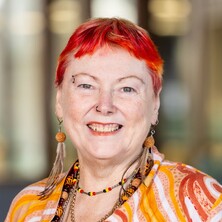
Emma Olssen is a Koori Aboriginal woman from the Wiradjuri Nation of New South Wales through her mother and grandparents, and a Middle-Eastern Australian through her father's lineage. Born in Muloobinba (Newcastle, NSW), she grew up in Winnam (Wynnum) on Quandamooka Country (Moreton Bay).
Emma has an extensive professional background in leadership, executive management, organisational change, and Indigenous engagement across diverse sectors. As an Indigenous researcher, her work is grounded in Indigenous methodologies and explores the experiences of Aboriginal and Torres Strait Islander employees across identified and non-identified roles.
Her research examines how organisational structures, workplace cultures, and employment practices shape Indigenous employees' experiences of inclusion, wellbeing, leadership, and career progression. Through qualitative yarning, her work challenges assumptions that representation alone leads to meaningful inclusion and highlights the organisational conditions that enable Aboriginal and Torres Strait Islander peoples to thrive in the workplace. Her research contributes to contemporary discussions on Indigenous employment, equity, and organisational transformation.
I am an Aboriginal woman from the Ngen'giwumirri language group (Daly River, Northern Territory), born in Brisbane and connected to Indigenous communities across South East Queensland. I currently hold the position of Professor and Deputy Head of School in the School of Education at The University of Queensland. My research program is nationally and internationally recognised, with a focus on Indigenous education, codesign in Indigenous education, Indigenous participation in STEM, youth studies, flexi schooling, and education policy. I lead an extensive externally funded research program, including Australian Research Council (ARC) grants and government tenders, and I actively contribute to policy development through advisory roles at both state and national levels. I am a Chief Investigator on the ARC Centre of Excellence for Indigenous Futures.
I am committed to advancing strengths-based approaches in Indigenous education. My scholarship includes over 100 publications, and I have co-edited two major texts in the field. The first, “Indigenous Education in Australia: Learning and Teaching for Deadly Futures” (Routledge, 2021), which received a national award at the Education Publishing Awards Australia. My most recent book, “Strengths-Based Approaches to Indigenous Education Research and Practice” (Routledge, 2025), co-edited with Professor Grace Sarra, further contributes to the growing body of work that centres Indigenous voices and leadership in education. My academic work builds on my foundation as a qualified, Queensland-registered secondary school teacher.
Throughout my career, I have received multiple awards in recognition of research excellence and leadership, including the UQ Foundation Research Excellence Award (2021), the UQ Award for Excellence in Graduate Research Leadership (2024), and the National ACEL Leadership Award (2020). As a qualified and experienced secondary teacher, I remain deeply committed to research translation and applied research that support advancing educational equity. I designed a specialised program aimed at growing the Indigenous Education research workforce, the SoE DEADLY Community, providing mentoring to early career researchers and supervising Indigenous higher degree research students through the creation of an environment that centres Indigenous strengths, knowledges and aspirations.
My work continues to be driven by a belief in the transformative power of education and the importance of Indigenous-led research and practice, underpinned by Indigenous-informed evidence, and a commitment to bridging research, policy and practice.
Faculty of Health, Medicine and Behavioural Sciences
Availability:
Available for supervision
Media expert
Jaimee is an applied cultural and developmental psychologist and Principal Research Fellow at the UQ Poche Centre for Indigenous Health. Her work examines human development within complex social systems with a focus on the experiences of marginalised, under-represented, and disadvantaged communities. Throughout her career she has worked to support the health and well-being of diverse minority groups (e.g. cultural, religious, gender, and sexual orientation) and those who experience inflated risk factors (e.g., exposure to violence, low socio-economic status, displacement). She is especially interested in how governance, community, and individual-level factors intersect with contemporary social issues including emerging technologies, intercultural relations, and social cohesion. Jaimee focuses on issues of social justice, peace, and equity with an emphasis on the empowerment of Indigenous, migrant and refugee background youth and families.
Jaimee has multisector research and leadership experience across the United Nations, government, and academia in Australia and Aotearoa. Most recently, she was Head of Research (Acting) at the United Nations University Institute in Macau, where she led a team examining the gender digital divide, the ethics of AI, and online violence among civil society in Asia-Pacific. Prior to that she held a senior research role at Griffith University where she led the research strategy for a large project in Logan aimed at alleviating the impacts of place-based disadvantage among diverse cultural groups. Jaimee has extensive experience in both quantitative and qualitative methods, knowledge mobilisation, and stakeholder engagement, and policy advisory.
Principal Specialty Supervisor in Indigenous Health Education and Engagment
Medical School (Rural Clinical School)
Faculty of Health, Medicine and Behavioural Sciences
Availability:
Not available for supervision
Leonie is proud of her traditional connections to the Djaku-nde people of North Burnett, Juru people in Bowen North Queensland and the Nuigi people of Mulgumpin (Moreton Island) with bloodline traces back to Tanna, Santo and Lifu Island's in Vanuatu. With over 30 years of experience in social work, Leonie is a nationally recognised leader in cultural safety, Indigenous engagement and community development. Leonie has extensive experience in across child protection, mental health and teritary education sectors. Her professional expereist encompasses policy development, legislative reform, and practice frameworks, with a strong emphasis on co-design, cultural mentoring and workforce development. She has lectured in Indigenous Health, Social Work, Mental Health and contributed to the development of culturally safe, student-centred curricula. Renowned for her authentic faciliation style, she empowers individuals and organisations to embed cultural safety and drive systemic change across government, non-government, and academic contexts.